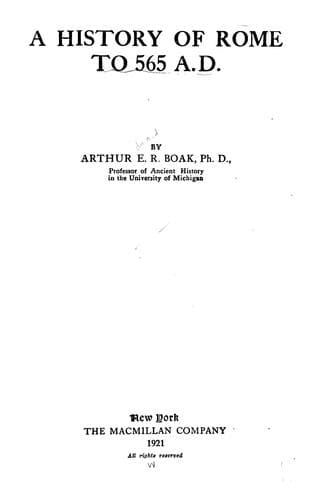
A History of Rome to 565 A. D.Boak, Arthur E. R. (Arthur Edward Romilly)
Philosophy
A History of Rome to 565 A. D.
Boak, Arthur E. R. (Arthur Edward Romilly)
Rome -- History
*Greek literature.* If we except the brief period of the Augustan age, the
Greek literature of the principate stands both in quantity and quality
above the Latin. Even Augustus had recognized Greek as the language of
government in the eastern half of the empire, and with the gradual
abandonment of his policy of preserving the domination of the Italians
over the provincials Greeks stood upon the same footing as the Latin
speaking provincials in the eyes of the imperial government. In Rome the
Greek author received the same recognition as his Roman _confrère_. Greek
historians, geographers, scientists, rhetoricians and philosophers wrote
not only for Greeks, but for the educated circles of the whole empire. And
it was in Greek that the princeps Marcus Aurelius chose to write his
Meditations. Nor should it be forgotten that Greek was the language of the
early Christian writers, beginning with the Apostle Paul. By the opening
of the third century the champions of the new faith had begun to rank
among the leading authors of the day in the East as well as in the West.
*Plutarch (c. 50–120 A. D.) and Lucian (c. 125–200 A. D.)**.* The best
known names in the Greek literature of the principate are Plutarch and
Lucian. Plutarch’s _Parallel Lives_ of famous Greeks and Romans possess a
perpetual freshness and charm. Lucian was essentially a writer of prose
satires, a journalist who was “the last great master of Attic eloquence
and Attic wit.” In the realm of science, Ptolemy the astronomer, and Galen
the student of medicine, both active in the second century, profoundly
influenced their own and subsequent times.
*Philosophy.* As we have seen, the doctrines of Stoicism continued to
appeal to the highest instincts of Roman character. Besides Seneca and
Marcus Aurelius this creed found a worthy exponent in the ex-slave
Epictetus, who taught between 90 and 120 A. D. at Nicopolis in Epirus.
With Plotinus (204–270 A. D.), Greek philosophy became definitely
religious in character, resting upon the basis of revelation and belief,
not upon that of reason.
Public-domain text, read in full here on John Shaqi.
Reviews
Reviews
No reviews yet
Be the first to share your thoughts on this work.
Elsewhere in the archive
Join the Discussion
Join the discussion
Sign in to leave a comment or review.
Sign InorCreate an account