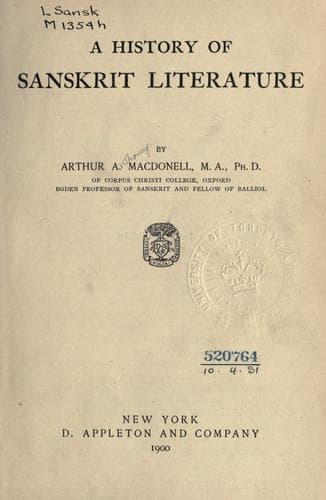
A History of Sanskrit LiteratureMacdonell, Arthur Anthony
History
A History of Sanskrit Literature
Macdonell, Arthur Anthony
Sanskrit literature -- History and criticism
Of the three later Vedas, the Samaveda is much the most closely
connected with the Rigveda. Historically it is of little importance,
for it contains hardly any independent matter, all its verses except
seventy-five being taken directly from the Rigveda. Its contents are
derived chiefly from the eighth and especially the ninth, the Soma
book. The Samaveda resembles the Yajurveda in having been compiled
exclusively for ritual application; for the verses of which it
consists are all meant to be chanted at the ceremonies of the soma
sacrifice. Removed from their context in the Rigveda, they are strung
together without internal connection, their significance depending
solely on their relation to particular rites. In form these stanzas
appear in the text of the Samaveda as if they were to be spoken or
recited, differing from those of the Rigveda only in the way of
marking the accent. The Samaveda is, therefore, only the book of
words employed by the special class of Ugatri priests at the soma
sacrifice. Its stanzas assume their proper character of musical Samans
or chants only in the various song-books called ganas, which indicate
the prolongation, the repetition, and the interpolation of syllables
necessary in singing, just as is often done in European publications
when the words are given below the musical notation. There are four
of these songbooks in existence, two belonging to each division of
the Veda. The number of Samans here given of course admitted of being
indefinitely increased, as each verse could be sung to many melodies.
Public-domain text, read in full here on John Shaqi.
Reviews
Reviews
No reviews yet
Be the first to share your thoughts on this work.
Elsewhere in the archive
Join the Discussion
Join the discussion
Sign in to leave a comment or review.
Sign InorCreate an account