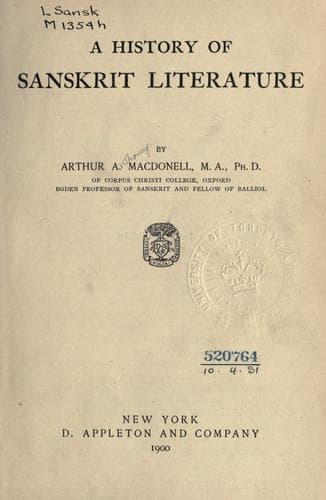
A History of Sanskrit LiteratureMacdonell, Arthur Anthony
History
A History of Sanskrit Literature
Macdonell, Arthur Anthony
Sanskrit literature -- History and criticism
Two schools of the Samaveda are known--the Kauthumas and the
Ranayaniyas, the former of whom are said still to exist in Gujarat,
while the latter, at one time settled mainly in the Mahratta country,
are said to survive in Eastern Hyderabad. Their recensions of the
text appear to have differed but little from each other. That of
the Ranayanayas has been published more than once. The earliest
edition, brought out by a missionary named Stevenson in 1842,
was entirely superseded by the valuable work of Benfey, which,
containing a German translation and glossary besides the text,
came out in 1848. The Samaveda was thus the first of the Vedas to
be edited in its entirety. The text of this Veda, according to the
recension of the same school, together with the commentary of Sayana,
was subsequently edited in India. Of the Kauthuma recension nothing has
been preserved excepting the seventh prapathaka, which, in the Naigeya
subdivision of this school, forms an addition to the first archika,
and was edited in 1868. Two indices of the deities and composers of the
Samaveda according to the Naigeya school have also been preserved, and
indirectly supply information about the text of the Kauthuma recension.
The Yajurveda introduces us not only to a geographical area different
from that of the Rigveda, but also to a new epoch of religious
and social life in India. The centre of Vedic civilisation is now
found to lie farther to the east. We hear no more of the Indus and
its tributaries; for the geographical data of all the recensions of
the Yajurveda point to the territory in the middle of Northern India
occupied by the neighbouring peoples of the Kurus and Panchalas. The
country of the former, called Kurukshetra, is specifically the holy
land of the Yajurvedas and of the Brahmanas attached to them. It lay
in the plain between the Sutlej and the Jumna, beginning with the
tract bounded by the two small rivers Drishadvati and Sarasvati,
and extending south-eastwards to the Jumna. It corresponds to the
modern district of Sirhind. Closely connected with, and eastward
of this region, was situated the land of the Panchalas, which,
running south-east from the Meerut district to Allahabad, embraces
the territory between the Jumna and the Ganges called the Doab ("Two
Waters"). Kurukshetra was the country in which the Brahmanic religious
and social system was developed, and from which it spread over the rest
of India. It claims a further historical interest as being in later
times the scene of the conflict, described in the Mahabharata, between
the Panchalas and Matsyas on the one hand, and the Kurus, including
the ancient Bharatas, on the other. In the famous lawbook of Manu the
land of the Kurus is still regarded with veneration as the special
home of Brahmanism, and as such is designated Brahmavarta. Together
with the country of the Panchalas, and that of their neighbours to the
south of the Jumna, the Matsyas (with Mathura, now Muttra, as their
Public-domain text, read in full here on John Shaqi.
Reviews
Reviews
No reviews yet
Be the first to share your thoughts on this work.
Elsewhere in the archive
Join the Discussion
Join the discussion
Sign in to leave a comment or review.
Sign InorCreate an account