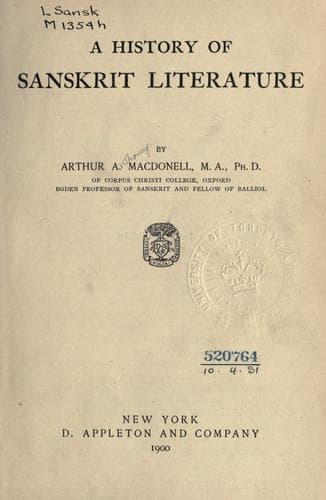
A History of Sanskrit LiteratureMacdonell, Arthur Anthony
History
A History of Sanskrit Literature
Macdonell, Arthur Anthony
Sanskrit literature -- History and criticism
The Rig-, Sama-, and Yajur-vedas alone were originally recognised as
canonical collections. For they only were concerned with the great
sacrificial ceremonial. The Atharva-veda, with the exception of the
last book, which was obviously added in order to connect it with
that ceremonial, is essentially unconnected with it. The ceremonial
to which its hymns were practically applied is, with few exceptions,
that with which the Grihya Sutras deal, being domestic rites such as
those of birth, marriage, and death, or the political rites relating
to the inauguration of kings. Taken as a whole, it is a heterogeneous
collection of spells. Its most salient teaching is sorcery, for it is
mainly directed against hostile agencies, such as diseases, noxious
animals, demons, wizards, foes, oppressors of Brahmans. But it also
contains many spells of an auspicious character, such as charms to
secure harmony in family and village life, reconciliation of enemies,
long life, health, and prosperity, besides prayers for protection
on journeys, and for luck in gambling. Thus it has a double aspect,
being meant to appease and bless as well as to curse.
In its main contents the Atharva-veda is more superstitious than
the Rigveda. For it does not represent the more advanced religious
beliefs of the priestly class, but is a collection of the most popular
spells current among the masses, who always preserve more primitive
notions with regard to demoniac powers. The spirit which breathes in
it is that of a prehistoric age. A few of its actual charms probably
date with little modification from the Indo-European period; for, as
Adalbert Kuhn has shown, some of its spells for curing bodily ailments
agree in purpose and content, as well as to some extent even in form,
with certain old German, Lettic, and Russian charms. But with regard
to the higher religious ideas relating to the gods, it represents
a more recent and advanced stage than the Rigveda. It contains,
indeed, more theosophic matter than any of the other Samhitas. For
the history of civilisation it is on the whole more interesting and
important than the Rigveda itself.
The Atharva-veda is extant in the recensions of two different
schools. That of the Paippaladas is, however, known in a single
birch-bark manuscript, which is ancient but inaccurate and mostly
unaccented. It was discovered by Professor Bühler in Kashmir, and
has been described by Professor Roth in his tract Der Atharvaveda
in Kaschmir (1875). It will probably soon be accessible to scholars
in the form of a photographic reproduction published by Professor
Bloomfield. This recension is doubtless meant by the "Paippalada
Mantras" mentioned in one of the Pariçishtas or supplementary writings
of the Atharva-veda.
Public-domain text, read in full here on John Shaqi.
Reviews
Reviews
No reviews yet
Be the first to share your thoughts on this work.
Elsewhere in the archive
Join the Discussion
Join the discussion
Sign in to leave a comment or review.
Sign InorCreate an account