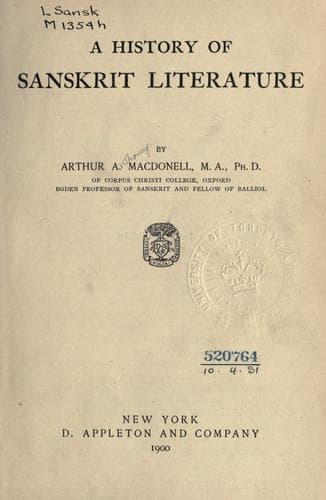
A History of Sanskrit LiteratureMacdonell, Arthur Anthony
History
A History of Sanskrit Literature
Macdonell, Arthur Anthony
Sanskrit literature -- History and criticism
The period in which the poetry of the Vedic Samhitas arose was
followed by one which produced a totally different literary type--the
theological treatises called Brahmanas. It is characteristic of the
form of these works that they are composed in prose, and of their
matter that they deal with the sacrificial ceremonial. Their main
object being to explain the sacred significance of the ritual to those
who are already familiar with the sacrifice, the descriptions they give
of it are not exhaustive, much being stated only in outline or omitted
altogether. They are ritual text-books, which, however, in no way aim
at furnishing a complete survey of the sacrificial ceremonial to those
who do not know it already. Their contents may be classified under the
three heads of practical sacrificial directions (vidhi), explanations
(arthavada), exegetical, mythological, or polemical, and theological or
philosophical speculations on the nature of things (upanishad). Even
those which have been preserved form quite an extensive literature by
themselves; yet many others must have been lost, as appears from the
numerous names of and quotations from Brahmanas unknown to us occurring
in those which are extant. They reflect the spirit of an age in which
all intellectual activity is concentrated on the sacrifice, describing
its ceremonies, discussing its value, speculating on its origin and
significance. It is only reasonable to suppose that an epoch like this,
which produced no other literary monuments, lasted for a considerable
time. For though the Brahmanas are on the whole uniform in character,
differences of age are traceable in them. Next to the prose portions
of the Yajurvedas, the Panchavimça and the Taittiriya are proved by
their syntax and vocabulary to be the most archaic of the regular
Brahmanas. This conclusion is confirmed by the fact that the latter
is, and the former is known to have been, accented. A more recent
group is formed by the Jaiminiya, the Kaushitaki, and the Aitareya
Brahmanas. The first of these is probably the oldest, while the
third seems, on linguistic grounds at least, to be the latest of the
three. The Çatapatha Brahmana, again, is posterior to these. For it
shows a distinct advance in matter; its use of the narrative tenses is
later than that of the Aitareya; and its style is decidedly developed
in comparison with all the above-mentioned Brahmanas. It is, indeed,
accented, but in a way which differs entirely from the regular Vedic
method. Latest of all are the Gopatha Brahmana of the Atharva and
the short Brahmanas of the Samaveda.
Public-domain text, read in full here on John Shaqi.
Reviews
Reviews
No reviews yet
Be the first to share your thoughts on this work.
Elsewhere in the archive
Join the Discussion
Join the discussion
Sign in to leave a comment or review.
Sign InorCreate an account