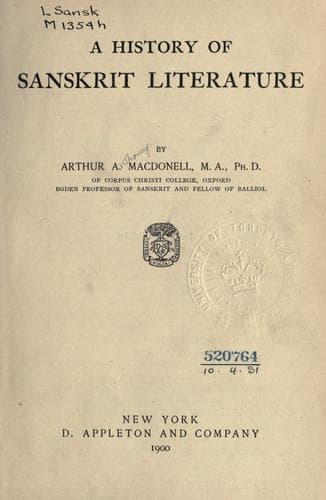
A History of Sanskrit LiteratureMacdonell, Arthur Anthony
History
A History of Sanskrit Literature
Macdonell, Arthur Anthony
Sanskrit literature -- History and criticism
The rite of upanayana is still practised in India. It is based on a
very old custom. The Avestan ceremony of investing the boy of fifteen
with a sacred cord upon his admission into the Zoroastrian community
shows that it goes back to Indo-Iranian times. The prevalence among
primitive races all over the world of a rite of initiation, regarded as
a second birth, upon the attainment of manhood, indicates that it was
a still older custom, which in the Brahman system became transformed
into a ceremony of admission to Vedic study.
Besides his studies, the course of which is regulated by detailed
rules, the constant duties of the pupil are the collection of fuel,
the performance of devotions at morning and evening twilight, begging
food, sleeping on the ground, and obedience to his teacher.
At the conclusion of religious studentship (brahmacharya), which lasted
for twelve years, or till the pupil had mastered his Veda, he performs
the rite of return (samavartana), the principal part of which is a
bath, with which he symbolically washes off his apprenticeship. He is
now a snataka ("one who has bathed"), and soon proceeds to the most
important sacrament of his life, marriage. The main elements of this
ceremony doubtless go back to the Indo-European period, and belong
rather to the sphere of witchcraft than of the sacrificial cult. The
taking of her hand placed the bride in the power of her husband. The
stone on which she stepped was to give her firmness. The seven steps
which she took with her husband, and the sacrificial food which she
shared with him, were to inaugurate friendship and community. Future
abundance and male offspring were prognosticated when she had been
conducted to her husband's house, by seating her on the hide of a
red bull and placing upon her lap the son of a woman who had only
borne living male children. The god most closely connected with
the rite was Agni; for the husband led his bride three times round
the nuptial fire--whence the Sanskrit name for wedding, pari-naya,
"leading round"--and the newly kindled domestic fire was to accompany
the couple throughout life. Offerings are made to it and Vedic formulas
pronounced. After sunset the husband leads out his bride, and as
he points to the pole-star and the star Arundhati, they exhort each
other to be constant and undivided for ever. These wedding ceremonies,
preserved much as they are described in the Sutras, are still widely
prevalent in the India of to-day.
All the above-mentioned sacraments are exclusively meant for males,
the only one in which girls had a share being marriage (vivaha). About
twelve of these Samskaras are still practised in India, investiture
being still the most important next to marriage. Some of the ceremonies
only survive in a symbolical form, as those connected with religious
studentship.
Public-domain text, read in full here on John Shaqi.
Reviews
Reviews
No reviews yet
Be the first to share your thoughts on this work.
Elsewhere in the archive
Join the Discussion
Join the discussion
Sign in to leave a comment or review.
Sign InorCreate an account