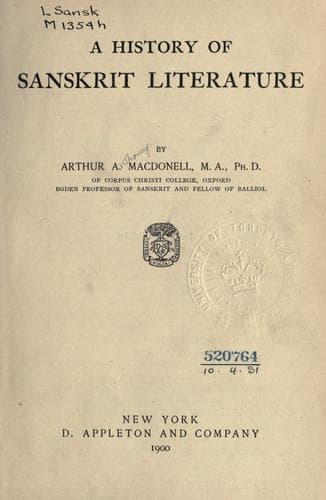
A History of Sanskrit LiteratureMacdonell, Arthur Anthony
History
A History of Sanskrit Literature
Macdonell, Arthur Anthony
Sanskrit literature -- History and criticism
It would be a mistake to suppose that Sanskrit literature came into
being only at the close of the Vedic period, or that it merely forms
its continuation and development. As a profane literature, it must,
in its earliest phases, which are lost, have been contemporaneous
with the religious literature of the Vedas. Beside the productions
of the latest Vedic period, that of the Upanishads and Sutras, there
grew up, on the one hand, the rich Pali literature of Buddhism, and,
on the other, the earliest form of Sanskrit poetry in the shape of
epic tales. We have seen that even the Rigveda contains some hymns
of a narrative character. Later we find in the Brahmanas a number
of short legends, mostly in prose, but sometimes partly metrical,
as the story of Çunahçepa in the Aitareya. Again, the Nirukta, which
must date from the fifth century B.C., contains many prose tales,
and the oldest existing collection of Vedic legend, the metrical
Brihaddevata, cannot belong to a much later time.
Sanskrit epic poetry falls into two main classes. That which
comprises old stories goes by the name of Itihasa, "legend," Akhyana,
"narrative," or Purana, "ancient tale," while the other is called
Kavya or artificial epic. The Mahabharata is the chief and oldest
representative of the former group, the Ramayana of the latter. Both
these great epics are composed in the same form of the çloka metre as
that employed in classical Sanskrit poetry. The Mahabharata, however,
also contains, as remnants of an older phase, archaic verses in the
upajati and vamçastha (developments of the Vedic trishtubh and jagati)
metres, besides preserving some old prose stories in what is otherwise
an entirely metrical work. It further differs from the sister epic in
introducing speeches with words, such as "Brihadaçva spake," which
do not form part of the verse, and which may be survivals of prose
narrative connecting old epic songs. The Ramayana, again, is, in the
main, the work of a single poet, homogeneous in plan and execution,
composed in the east of India. The Mahabharata, arising in the western
half of the country, is a congeries of parts, the only unity about
which is the connectedness of the epic cycle with which they deal; its
epic kernel, moreover, which forms only about one-fifth of the whole
work, has become so overgrown with didactic matter, that in its final
shape it is not an epic at all, but an encyclopædia of moral teaching.
Public-domain text, read in full here on John Shaqi.
Reviews
Reviews
No reviews yet
Be the first to share your thoughts on this work.
Elsewhere in the archive
Join the Discussion
Join the discussion
Sign in to leave a comment or review.
Sign InorCreate an account