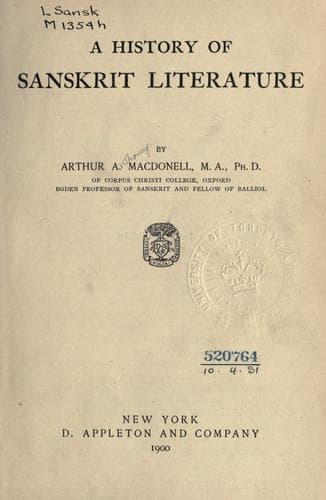
A History of Sanskrit LiteratureMacdonell, Arthur Anthony
History
A History of Sanskrit Literature
Macdonell, Arthur Anthony
Sanskrit literature -- History and criticism
Thus the great King Vikramaditya vanishes from the historical ground
of the sixth century into the realm of myth. With Vikramaditya an
often-quoted but ill-authenticated verse occurring in a work of the
sixteenth century associates Dhanvantari, Kshapanaka, Amarasimha,
Varahamihira, and Vararuchi as among the "nine gems" of his court. With
the disappearance of Vikrama from the sixth century A.D. this verse
has lost all chronological validity with reference to the date of
the authors it enumerates; it is even inadmissible to conclude from
such legendary testimony that they were contemporaries. Even though
one of them, Varahamihira, actually does belong to the sixth century,
each of them can now only be placed in the sixth century separately
and by other arguments. Apart from the mythical Vikramaditya, there
is now no reason to suppose that court poetry attained a special
development in that century, for Harishena's paneygyric, and some
other epigraphic poems of the Gupta period, show that it flourished
greatly at least two hundred years earlier.
None of the other arguments by which it has been attempted to place
Kalidasa separately in the sixth century have any cogency. One of
the chief of these is derived from the explanation given by the
fourteenth-century commentator, Mallinatha, of the word dignaga,
"world-elephant," occurring in the 14th stanza of Kalidasa's
Meghaduta. He sees in it a punning allusion to Dignaga, a hated
rival of the poet. This explanation, to begin with, is extremely
dubious in itself. Then it is uncertain whether Mallinatha means the
Buddhist teacher Dignaga. Thirdly, little weight can be attached to
the Buddhistic tradition that Dignaga was a pupil of Vasubandhu, for
this statement is not found till the sixteenth century. Fourthly, the
assertion that Vasubandhu belongs to the sixth century depends chiefly
on the Vikramaditya theory, and is opposed to Chinese evidence, which
indicates that works of Vasubandhu were translated in A.D. 404. Thus
every link in the chain of this argument is very weak.
The other main argument is that Kalidasa must have lived after
Aryabhata (A.D. 499), because he shows a knowledge of the scientific
astronomy borrowed from the Greeks. But it has been shown by
Dr. Thibaut that an Indian astronomical treatise, undoubtedly written
under Greek influence, the Romaka Siddhanta, is older than Aryabhata,
and cannot be placed later than A.D. 400. It may be added that a
passage of Kalidasa's Raghuvamça (xiv. 40) has been erroneously
adduced in support of the astronomical argument, as implying that
eclipses of the moon are due to the shadow of the earth: it really
refers only to the spots in the moon as caused, in accordance with
the doctrine of the Puranas, by a reflection of the earth.
Public-domain text, read in full here on John Shaqi.
Reviews
Reviews
No reviews yet
Be the first to share your thoughts on this work.
Elsewhere in the archive
Join the Discussion
Join the discussion
Sign in to leave a comment or review.
Sign InorCreate an account