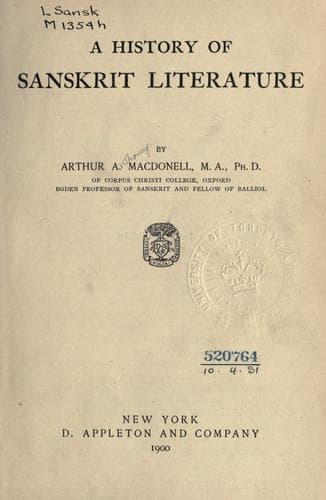
A History of Sanskrit LiteratureMacdonell, Arthur Anthony
History
A History of Sanskrit Literature
Macdonell, Arthur Anthony
Sanskrit literature -- History and criticism
The narrative in the Raghuvamça moves with some rapidity, not being
too much impeded by long descriptions. It abounds with apt and striking
similes and contains much genuine poetry, while the style, for a Kavya,
is simple, though many passages are undoubtedly too artificial for
the European taste. The following stanza, sung by a bard whose duty it
is to waken the king in the morning (v. 75), may serve as a specimen--
The flow'rs to thee presented droop and fade,
The lamps have lost the wreath of rays they shed,
Thy sweet-voiced parrot, in his cage confined,
Repeats the call we sound to waken thee.
More than twenty commentaries on the Raghuvamça are known. The most
famous is the Samjivani of Mallinatha, who explains every word of
the text, and who has the great merit of endeavouring to find out
and preserve the readings of the poet himself. He knew a number
of earlier commentaries, among which he names with approval those
of Dakshinavarta and Natha. The latter no longer exist. Among the
other extant commentaries may be mentioned the Subodhini, composed
by Dinakara Miçra in 1385, and the Çiçuhitaishini, by a Jain named
Charitravardhana, of which Dinakara's work appears to be an epitome.
The Kumara-sambhava, or the "Birth of the War-god," consists, when
complete, of seventeen cantos. The first seven are entirely devoted
to the courtship and wedding of the god Çiva and of Parvati, daughter
of Himalaya, the parents of the youthful god. This fact in itself
indicates that description is the prevailing characteristic of the
poem. It abounds in that poetical miniature painting in which lies
the chief literary strength of the Indian. Affording the poet free
scope for the indulgence of his rich and original imaginative powers,
it is conspicuous for wealth of illustration. The following rendering
of a stanza in the Viyogini metre (in which lines of ten and eleven
syllables ending iambically alternate) may serve as a specimen. The
poet shows how the duty of a wife following her husband in death is
exemplified even by objects in Nature poetically conceived as spouses--
After the Lord of Night the moonlight goes,
Along with the cloud the lightning is dissolved:
Wives ever follow in their husbands' path;
Even things bereft of sense obey this law.
Usually the first seven cantos only are to be found in the printed
editions, owing to the excessively erotic character of the remaining
ten. The poem concludes with an account of the destruction of the
demon Taraka, the object for which the god of war was born.
More than twenty commentaries on the Kumara-sambhava have been
preserved. Several of them are by the same authors, notably Mallinatha,
as those on the Raghuvamça.
Public-domain text, read in full here on John Shaqi.
Reviews
Reviews
No reviews yet
Be the first to share your thoughts on this work.
Elsewhere in the archive
Join the Discussion
Join the discussion
Sign in to leave a comment or review.
Sign InorCreate an account