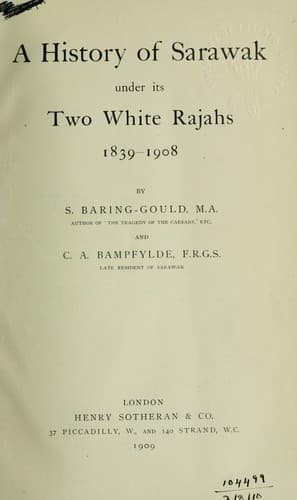
A History of Sarawak under Its Two White Rajahs 1839-1908Baring-Gould, S. (Sabine)
History
A History of Sarawak under Its Two White Rajahs 1839-1908
Baring-Gould, S. (Sabine)
Charles, Rajah of Sarawak, 1829-1917; James, Rajah of Sarawak, 1803-1868; Sarawak (Malaysia) -- History
Sherip Sahap, after residing for a short time in the Kapuas, in Dutch
Borneo, died of a broken heart at Pontianak. Sherip Mular, who also
escaped over the border, subsequently sued for forgiveness, but this was
then refused.[125] Sherip Japar, who the previous year had rendered good
service against the Saribas pirates, was removed to Ensingai in the
Sadong. Pangiran Makota, who so richly deserved death, and who as a
matter of policy alone, as well as in the interests of humanity, should
have been executed, was spared by the Rajah, and allowed to retire to
Bruni, with what results we have already noted.
Early the next year the Saribas and Sekrang Dayaks visited the Rajah at
Kuching and formally tendered their submission. The promises then made
of future good behaviour would probably have been observed, and those,
of which there was now a large party, in favour of peace have been
upheld, had the British Government afforded the Rajah continuous support
for a short time, even in the shape of a small brig-of-war. "We must
progress or retrograde" was the Rajah's timely, though unheeded warning.
But the desired support was denied, and gradually the piratical party
again became dominant, and in less than two years found themselves in a
position once more to defy the Rajah, and to spread terror along the
coast. But with this, and their final, though tardy punishment, we shall
deal later.
The Rajah seeing how precarious his position was, had offered the
cession of Sarawak to the British Crown without remuneration, though he
had now laid out £10,000 upon its development. He showed how by
developing the trade and the natural wealth of the land through British
influence, river after river might be opened up to commerce. He
entreated that steady and unremitting efforts should be made for the
suppression of piracy. But the Government shrank from the extension of
its Colonies, it was afraid of being dragged into a second New Zealand
scheme, and it consented, reluctantly, to afford him help, and that but
inadequate, against the pirates.
Public-domain text, read in full here on John Shaqi.
Reviews
Reviews
No reviews yet
Be the first to share your thoughts on this work.
Elsewhere in the archive
Join the Discussion
Join the discussion
Sign in to leave a comment or review.
Sign InorCreate an account