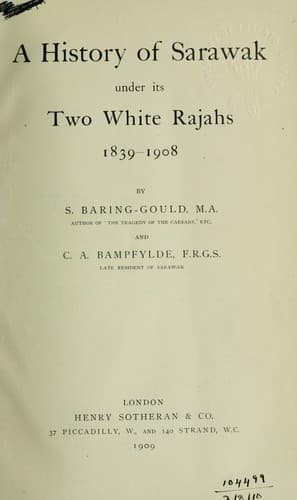
A History of Sarawak under Its Two White Rajahs 1839-1908Baring-Gould, S. (Sabine)
History
A History of Sarawak under Its Two White Rajahs 1839-1908
Baring-Gould, S. (Sabine)
Charles, Rajah of Sarawak, 1829-1917; James, Rajah of Sarawak, 1803-1868; Sarawak (Malaysia) -- History
And now honours rained on him. He was presented with the freedom of the
City of London; Oxford University conferred upon him the degree of
LL.D.; he was graciously received at Windsor by the Queen and the Prince
Consort; was appointed Governor of Labuan, and Commissioner and
Consul-General in Borneo, and made a K.C.B.[152] The United Service, the
Army and Navy, the Athenæum, Travellers, and other Clubs elected him an
honorary member. He was lionised and fêted, and was received with marked
distinction by every one, including Ministers.
He sailed from England on February 1, 1848, with his Labuan staff, in
the _Mæander_, commanded by his old friend and ally, Captain Keppel, and
having the present Rajah on board as sub-lieutenant.[153] After spending
a few months in Singapore making preparations for the establishment of
his new colony, he arrived at the Muaratebas entrance of the Sarawak
river in September; here he left the _Mæander_, and was triumphantly
escorted up-river by the whole Kuching population amidst general
rejoicings.
He found affairs in his little raj had not been conducted quite so well
as he could have wished, and that there were evidences of renewed
activity on the part of the pirates. Pangiran Makota was in power at
Bruni, and that was a menace to the good conduct of both the external
and internal affairs of the Sultanate. The Sultan had been in direct
communication with the Sekrang Dayaks, amongst whom both Sherip Mular
and Sherip Ahmit were busy intriguing, and collecting the dissatisfied
party which had been scattered. Hostile operations on the part of the
Saribas were only checked by the arrival of the _Mæander_.
On September 14, the Rajah was joined by his nephew, Captain James
Brooke-Johnson,[154] of the Connaught Rangers, as his official A.D.C. He
assumed the surname of his uncle, and was given the title of Tuan Besar.
Although he was always looked upon as the heir-presumptive, the title of
Rajah Muda was only conferred upon him when he was officially and
publicly recognised by the Rajah as his heir in 1861.
"To give a spirit of national pride to the natives," the Rajah now
granted the country a flag,[155] and this was hoisted with due ceremony
on September 21. Viscount Palmerston, in a despatch dated June 20, 1849,
subsequently conveyed the approval of H.M.'s Government of the flag
having been hoisted, in order, with the sanction of the British
Government, to afford a recognised permanency to the country.
Public-domain text, read in full here on John Shaqi.
Reviews
Reviews
No reviews yet
Be the first to share your thoughts on this work.
Elsewhere in the archive
Join the Discussion
Join the discussion
Sign in to leave a comment or review.
Sign InorCreate an account