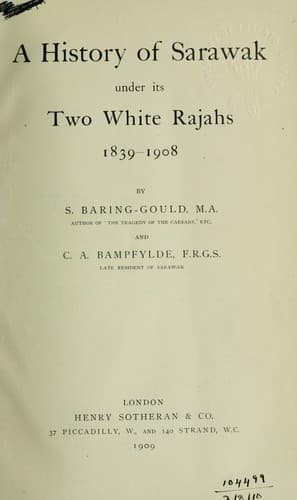
A History of Sarawak under Its Two White Rajahs 1839-1908Baring-Gould, S. (Sabine)
History
A History of Sarawak under Its Two White Rajahs 1839-1908
Baring-Gould, S. (Sabine)
Charles, Rajah of Sarawak, 1829-1917; James, Rajah of Sarawak, 1803-1868; Sarawak (Malaysia) -- History
An artifice of these pirates, and they never attempted by force what
could be acquired by stratagem, was this: some of the party remained
behind and assumed the clothes of their victims, and the umbrella-shaped
hats of palm leaf commonly used by those harvesting in the sun, which
would completely conceal their features; thus disguised they paddled
down stream, and called in Malay to the women to issue from their
hiding-places, as they had come to convey them to a place of safety. The
poor creatures, supposing that these were of their own tribe, ran down
with their children in their arms only to be speared and their heads
hacked off by these wolves in sheep's clothing.[159] On the last day of
February, a numerous and industrious population was gathering in the
harvest, and on March the 1st every house was plundered, and scattered
about the fields were the mangled bodies of the reapers, and in the
villages lay the headless trunks of men, aged women, and children too
young for captivity.
Not a day passed without news reaching Kuching of some village burned or
of some trading vessel captured. After the attack on Sadong, while the
Saribas hovered along the coast, crowds of refugees arrived in Kuching.
From all parts they came; from the river of Matu alone twenty prahus
full of men, women, and children, and from Kalaka many hundreds. They
said that they could endure life no longer in their own country,
continually engaged in resisting these murderous attacks, and losing
numbers of their people at the hands of the Sekrangs and Saribas.
"No news except of Dayaks, and rumours of Dayaks. Dayaks here, Dayaks
there, and Dayaks everywhere," so wrote the Rajah.
The Kalaka river had also been laid waste. Hunt in 1812 described Kalaka
as being one of the principal ports of trade on the north-west
coast,[160] and the country as producing large quantities of grain. But
this was before the Sea-Dayaks had become pirates. In 1849, the river
had been so devastated by piratical attacks that all cultivation had
been abandoned, and its once flourishing town and villages deserted,
with the exception of two that were small. "Never before had I been so
struck with the irreparable mischief done by the piratical tribes, as
when I saw this lovely country so completely deserted," so wrote Mr. S.
St. John in 1849.
The ravages of these murderous Dayaks had been peculiarly destructive in
the delta of the Rejang, once well populated by the quiet and
industrious Melanaus, the producers of the Bornean sago brought to the
market of Singapore. The pirates not only destroyed the villages and
plantations, but captured many richly laden prahus, freighted with the
produce of this district on their way to dispose of their lading in the
British Settlement of Singapore, and in Sambas and Pontianak. Like the
Malays of Kalaka, nearly all the inhabitants had fled, most to Sarawak,
some to other places.
Public-domain text, read in full here on John Shaqi.
Reviews
Reviews
No reviews yet
Be the first to share your thoughts on this work.
Elsewhere in the archive
Join the Discussion
Join the discussion
Sign in to leave a comment or review.
Sign InorCreate an account