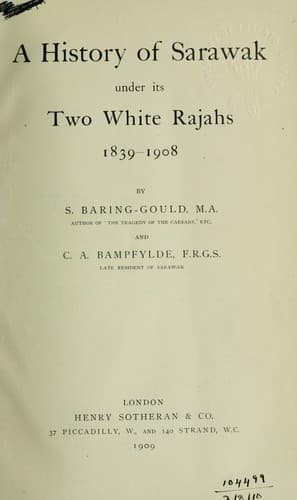
A History of Sarawak under Its Two White Rajahs 1839-1908Baring-Gould, S. (Sabine)
History
A History of Sarawak under Its Two White Rajahs 1839-1908
Baring-Gould, S. (Sabine)
Charles, Rajah of Sarawak, 1829-1917; James, Rajah of Sarawak, 1803-1868; Sarawak (Malaysia) -- History
The Ministry made no attempt to remove the harmful impressions caused by
the false step they had so weakly been induced to take; they but
confirmed these by making no _amende_, and by withdrawing all support,
and as the sequel will show, the Commission paved the way for the
rebellion of the Chinese, and for the outbreak of disaffected Malays and
other natives, aided and incited by intriguing Brunis, which were to
follow, and which cost the lives of many Europeans, and great numbers of
Chinese and natives, and nearly resulted in the extinction of the raj.
With justice the Rajah wrote: "It is a sad thing to say, but true as
sad, that England has been the worst opponent of the progress of
Sarawak, and is now the worst enemy of her liberty."
-----
Footnote 108:
The Governor-General of Netherlands East Indies in a rescript, dated
January 23, 1846, acknowledged that the exertions during the past
twenty-five years effectually to suppress piracy on the coasts of
Borneo had not been successful for want of combination, and for having
been limited to the western coast.
Footnote 109:
_A Collection of Voyages_, 1729.
Footnote 110:
Sulu was the principal market for the disposal of captives and
plunder.
Footnote 111:
A son of Captain Francis Light, who founded Penang in 1786, was named
Lanoon, he having been born on the island at the time it was being
blockaded by Lanun pirates.
Footnote 112:
Dayak war-boats, some having as many as 75 to the crew.
Footnote 113:
_Expedition to Borneo of H.M.S. Dido_, 1847.
Footnote 114:
On behalf of the Sultan, Saribas and Sekrang being beyond Rajah
Brooke's jurisdiction.
Footnote 115:
Keppel, _op. cit._
Footnote 116:
These Sea-Dayaks, together with those of the Undup, also an affluent
of the Batang Lupar, subsequently became the mainstay of the
Government against the Saribas and Sekrangs.
Footnote 117:
_Life of Sir James Brooke_, p. 84.
Footnote 118:
Sir Edward's report upon Sarawak appears to have been favourable; he
pronounced the coal at Bruni, which he never examined, to be
unworkable, and the Sultan to be a savage.
Footnote 119:
Pronounced by the natives _Achi_.
Footnote 120:
More correctly Putusan, or Pemutus. We retain the old spelling.
Footnote 121:
These guns realised £900 at public auction in Singapore.
Footnote 122:
Public-domain text, read in full here on John Shaqi.
Reviews
Reviews
No reviews yet
Be the first to share your thoughts on this work.
Elsewhere in the archive
Join the Discussion
Join the discussion
Sign in to leave a comment or review.
Sign InorCreate an account