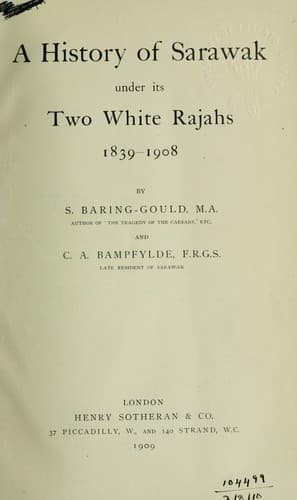
A History of Sarawak under Its Two White Rajahs 1839-1908Baring-Gould, S. (Sabine)
History
A History of Sarawak under Its Two White Rajahs 1839-1908
Baring-Gould, S. (Sabine)
Charles, Rajah of Sarawak, 1829-1917; James, Rajah of Sarawak, 1803-1868; Sarawak (Malaysia) -- History
Yellow ground, with black and red cross, as shown in illustration—the
arms of the Brookes. The Government flag is distinguished by a crown
in the centre; the Rajah's flag is a burgee, or swallow-tailed flag.
Footnote 156:
Keppel, _Voyage to the Indian Archipelago_.
Footnote 157:
_Private Letters._
Footnote 158:
Of his fifteen sons, Abangs Apong, Chek, Tek, and Bunsu all served the
Government afterwards; they were distinguished more for bravery than
for rectitude, but they were faithful and useful servants. Another son
was killed during the operations up the Saribas subsequent to the
action of Beting Maru. The Laksamana lived for years after these
events, and was about ninety when he died.
Footnote 159:
Keppel, _op. cit._
Footnote 160:
The plains on both banks of the river evidence a former cultivation on
an extensive scale.
Footnote 161:
St. John, _Life of Sir James Brooke_.
Footnote 162:
An army in Malay and Dayak.
Footnote 163:
Afterwards Admiral Sir Arthur Farquhar, K. C. B. He died in 1908, aged
ninety-three.
Footnote 164:
Anglice, King Lion.
Footnote 165:
Beting Maru is the name of a long sand-spit running into the sea
between the Kalaka and Saribas rivers off the Maru river.
Footnote 166:
This same Linggir in 1845 attempted to murder the Rajah and his
officers and other English guests whilst at dinner in the Rajah's
house at Kuching. He marched into the dining-room with eighty armed
men, pretending to pay a friendly visit. The Rajah and his guests
adopted the only policy open to them, and pretended as well to be
friendly, for they were completely at the mercy of the Dayaks. They
entertained their unwelcome guests with wine and cigars whilst waiting
for the Datus, to whom the Rajah had contrived covertly to send a
message. The Datu Temanggong arrived first with thirty men, and then
came the Datu Bandar with fifty men. The Datus wished to kill Linggir
for his intended treachery, the Rajah, however, spared him, perhaps
unwisely, but he had to slink away to his boat with a flea in his ear.
He had actually brought with him a basket to contain the Rajah's head.
He afterwards became a peaceable citizen, and very friendly to the
white men.
Footnote 167:
These unfortunate girls, and those taken at Matu, were barbarously
murdered by the pirates to prevent their being rescued.
Footnote 168:
Or better, Mashhor, an Arabic word meaning illustrious.
Footnote 169:
Mr. W. Brereton first came to Sarawak in the _Samarang_, as a
midshipman, in 1843. In 1848 he left the Navy and joined the Rajah. He
was first stationed at Labuan. He was only twenty years of age when
appointed to take charge of Sekrang.
Footnote 170:
The Sekrangs lost heavily at the battle of Beting Maru.
Footnote 171:
_Private Letters._
Footnote 172:
_Private Letters._
Footnote 173:
Public-domain text, read in full here on John Shaqi.
Reviews
Reviews
No reviews yet
Be the first to share your thoughts on this work.
Elsewhere in the archive
Join the Discussion
Join the discussion
Sign in to leave a comment or review.
Sign InorCreate an account