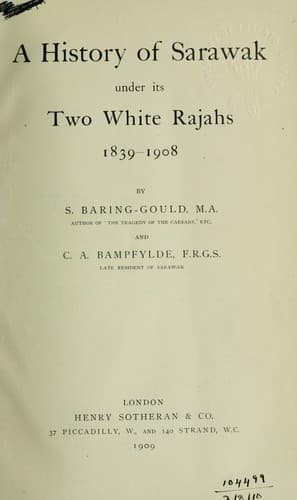
A History of Sarawak under Its Two White Rajahs 1839-1908Baring-Gould, S. (Sabine)
History
A History of Sarawak under Its Two White Rajahs 1839-1908
Baring-Gould, S. (Sabine)
Charles, Rajah of Sarawak, 1829-1917; James, Rajah of Sarawak, 1803-1868; Sarawak (Malaysia) -- History
The small boats in which were the Malay garrison were being swamped by
the heavy bangkongs or war prahus of the Sekrangs filled with armed men.
Brereton's boat upset, and with difficulty he reached the bank. Lee
refused to retreat, and calling out, "Save yourselves, I must stand,"
dashed on. His boat was boarded by the enemy; he fought with
desperation, but was overpowered and fell into the water with his head
nearly severed from his shoulders. Meanwhile the force of the current
had carried the fleet under the guns of the stockade, and these opened
fire upon it, and compelled Rentap reluctantly to withdraw and abandon
his undertaking.[191] He was followed up and attacked by the Sekrang
Dayak chief Gasing, who, acting on his own initiative, burnt twenty
villages belonging to Rentap's followers.
When the news of this disaster reached Kuching, the Tuan Muda was
recalled from Lundu and ordered to replace Lee at Lingga, and he arrived
there in June, 1853. A stronger fort was now built there, and the Malays
living at Banting were ordered to move down. He was succeeded at Lundu
by Mr. Charles Grant.[192]
Lingga, which is just at the mouth of the river of that name that flows
into the Batang Lupar about sixteen miles above its mouth, is seated on
a mud bank; the land for miles around is a dismal swamp, and is the most
dreary station in the State. It is, however, a healthy place, and
another redeeming point is the fine expanse of water which forms the
estuary of the Bantag Lupar, stretching from Lingga, where it is three
miles broad, straight to the mouth.
The Dayak population of the Lingga river was then about 5000, all
Balaus, whom the Tuan Muda found to be "braver than most Dayaks, and
true-hearted." From the first, they and the Seboyaus, a relative tribe,
residing some at Seboyau, below Lingga, but most at Lundu, had sided
with the Rajah against their direst foes, the Saribas; and these pages
record many great services rendered by them. Besides these Dayaks there
was a considerable number of Malays, and the latter increased, for
Lingga became to them a place of refuge.
Public-domain text, read in full here on John Shaqi.
Reviews
Reviews
No reviews yet
Be the first to share your thoughts on this work.
Elsewhere in the archive
Join the Discussion
Join the discussion
Sign in to leave a comment or review.
Sign InorCreate an account