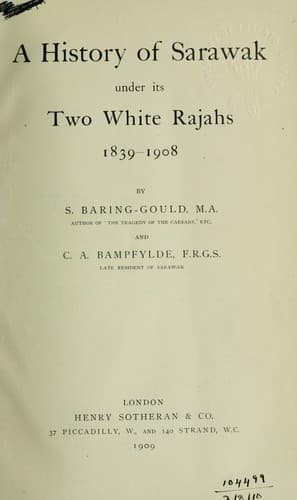
A History of Sarawak under Its Two White Rajahs 1839-1908Baring-Gould, S. (Sabine)
History
A History of Sarawak under Its Two White Rajahs 1839-1908
Baring-Gould, S. (Sabine)
Charles, Rajah of Sarawak, 1829-1917; James, Rajah of Sarawak, 1803-1868; Sarawak (Malaysia) -- History
In the Saribas, which was still a hornet's nest, affairs were coming to
a head. The Dayaks were about to retire into the interior with the Datu
Patinggi of Saribas, who, together with the Laksamana, was encouraging
the Dayaks to continue in their evil courses. But for the Malays, and
even amongst them there were many inclined to a life of peace, though
these were in a minority, the Dayaks of the lower Saribas would have
submitted to the Government, and amongst the latter the Rajah could now
count many adherents; but the power of the evilly disposed Malay chiefs,
headed by the Patinggi, and of the Dayak chiefs, headed by Rentap, was
dominant in the Saribas. To check them the Rajah took a large force to
that river, and went at the time that the Tuan Muda was starting on his
expedition, so as to disguise the object of the latter's preparations,
by leading the people to suppose that his intention was to support the
Rajah; and to be at hand to attack the Saribas Dayaks in rear should
they muster in force to assist Rentap. The Tuan Besar at the same time
went to the Rejang, to hold the Dayaks of that river in check.
The Tuan Muda took no Europeans with him, fearing that the fatigue of
the difficult overland march might knock them up, and cause them to
become encumbrances; his force consisted of 3500 Dayaks, and 500 Malays,
all willing volunteers, though many conceived the task to be beyond
their powers; but where he went they were ready to follow, confident
that under his direction they would be well led.
The expedition started on June 2, 1857, a little over three months after
the Chinese insurrection, and left Sekrang in drizzling rain; throughout
it encountered miserable weather, which damped the ardour of the force.
The Malays especially cannot endure wet, a few days' exposure brings on
fever and ague, and the cold, to which the Dayaks would be exposed on
the mountain, was likely to so numb them as to render them useless.
Old Sandom was once more the guide. He had his personal wrong to avenge,
as we have already stated. "Iron Anchor" and Pangiran Matali were again
the leaders.
Public-domain text, read in full here on John Shaqi.
Reviews
Reviews
No reviews yet
Be the first to share your thoughts on this work.
Elsewhere in the archive
Join the Discussion
Join the discussion
Sign in to leave a comment or review.
Sign InorCreate an account