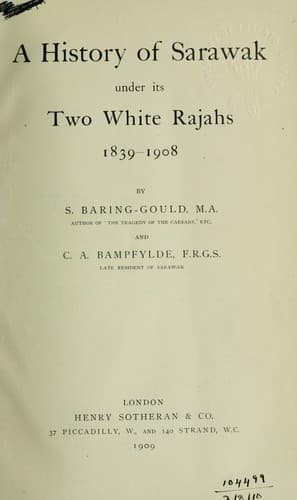
A History of Sarawak under Its Two White Rajahs 1839-1908Baring-Gould, S. (Sabine)
History
A History of Sarawak under Its Two White Rajahs 1839-1908
Baring-Gould, S. (Sabine)
Charles, Rajah of Sarawak, 1829-1917; James, Rajah of Sarawak, 1803-1868; Sarawak (Malaysia) -- History
At the mouth of the Langit river a stockade was erected. Here on a clear
night the moon was eclipsed. The Tuan Muda had seen by his almanack that
this would occur, and had announced to the host that it would take
place. If this had not been done a panic would have ensued, and the
natives would have insisted on leaving; but as it was, they conceived
that the phenomenon had been ordered by the white chief, to strike
terror into the hearts of their foes, as also to encourage them; they
were accordingly in good heart to advance.
They pushed on readily enough to Nanga Tiga,[206] the junction of three
rivers, one flowing from Sadok, one from the watershed where rises the
Kanowit river, and the third the main Saribas. Here the boats were to be
left, and a stout stockade was erected. Thence preparations were made to
advance up-country towards the Rejang. The Tuan Muda, with whom went
Cruickshank, was in command and led the van. Messrs. Steele and Fox[207]
were to take charge of the rear division. The whole party comprised 200
Malays and 2000 Dayaks.
From Nanga Tiga this party made for the head-waters of the Kajulau, to
lay waste the territory of the troublesome natives there. It may seem,
and it does seem at first sight, and to such as are not acquainted with
native warfare, a barbarous process to burn villages and destroy the
padi-fields with the crops on which the natives subsist. But, as already
said, it is the only way in which these savages can be brought to
submission. The women indeed suffer, but then they are the principal
instigators of all the attacks on inoffensive tribes. They rather than
the men were greedy after heads, and scoff at their husbands or
sweethearts as milksops if they remain at home, and do not go forth to
massacre and plunder. In fact, the destruction of their homes strikes
the women to the heart, and turns them into advocates of peace. Among
the Dayaks the women are a predominant power. The Dayaks are as
woman-ridden and as henpecked as are Englishmen. Moreover, the
destruction of native buildings is a more merciful proceeding than the
slaying of a number of men in battle.
After the return of this ravaging party, which had done a circuit of
thirty miles, a day was given to rest, and then the main body prepared
to march to Sadok; and this time the expedition was furnished with a
mortar that was expected to bring down Rentap's fortification. It was a
six-pounder and only a few inches long, and was carried by Dayaks slung
in a network of rattans.
Without opposition the host approached the fort of Sadok.
Public-domain text, read in full here on John Shaqi.
Reviews
Reviews
No reviews yet
Be the first to share your thoughts on this work.
Elsewhere in the archive
Join the Discussion
Join the discussion
Sign in to leave a comment or review.
Sign InorCreate an account