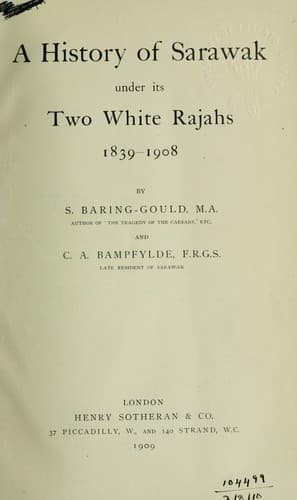
A History of Sarawak under Its Two White Rajahs 1839-1908Baring-Gould, S. (Sabine)
History
A History of Sarawak under Its Two White Rajahs 1839-1908
Baring-Gould, S. (Sabine)
Charles, Rajah of Sarawak, 1829-1917; James, Rajah of Sarawak, 1803-1868; Sarawak (Malaysia) -- History
Pangiran Matali (Muhammad Ali) was a brave man, honest and faithful.
He was a Government chief and magistrate, and his death, a few years
ago, was felt as a severe loss. He had a very thorough knowledge of
the Dayaks, and was a capable man in handling them. He was a prince by
birth of the royal blood of Bruni. He stands out as an example of what
such princes were capable of becoming under a just government.
Footnote 190:
Abang Aing was the head Government chief and native magistrate at
Sekrang, a post he held with distinction, noted for his fair and
impartial judgments, till his death, which took place in December,
1884. He and Pangiran Matali were the present Rajah's main supporters
and most trusted servants in the old troublesome days; and their names
stand foremost amongst those Malay chiefs who won an honourable place
in the annals of Sarawak for devotion to the cause of law and order.
Footnote 191:
S. St. John, in his _Life of Sir James Brooke_, says that Rentap took
Lee's head, but this was not the case.
Footnote 192:
Mr. C. Grant of Kilgraston, N.B., was a midshipman on the _Mæander_
when that ship brought the Rajah out from England. He became the
Rajah's private secretary in September, 1848. He retired in 1863.
Footnote 193:
These are titles of Sanskrit origin bestowed by the Sultan, the
meanings of which are somewhat obscure. The first probably means "the
revered Lord"; the third "high in eminence"; as regards the second,
Pelawan may mean the name of a place, otherwise it is untranslatable.
Footnote 194:
Apai = the father of.
Footnote 195:
As in the case of Mr. Lee, little has been recorded of Mr. H. Steele.
He did good service at the battle of Beting Maru, and probably joined
in 1848. He was selected by the Rajah to take charge of the fort at
Kanowit when it was built, and there he was murdered in 1859. He was a
noted linguist.
Footnote 196:
Brass cannon of Malay manufacture.
Footnote 197:
Seman was a Kalaka Malay living in Kuching, and had been made a
penglima by the Rajah for his courage and dash. His name still
survives in Kampong Penglima Seman—the village, or parish, of Penglima
Seman, within the township of Kuching.
Footnote 198:
The brutal and disgusting behaviour of the women on the arrival of a
fresh "trophy," to one who has witnessed it, would choke off any pity
for them.
Footnote 199:
These articles and other valuables, though a bitter loss, can be
replaced. But the destruction of their homes, rice-stores and standing
crops, household goods, cooking utensils and clothing, pigs, poultry,
and hunting dogs, boats and paddles, and farming implements are losses
that it takes two years to regain, and which reduces them for the time
to a condition of beggary.
Footnote 200:
Sauh Besi, a powerfully built Malay.
Footnote 201:
Public-domain text, read in full here on John Shaqi.
Reviews
Reviews
No reviews yet
Be the first to share your thoughts on this work.
Elsewhere in the archive
Join the Discussion
Join the discussion
Sign in to leave a comment or review.
Sign InorCreate an account