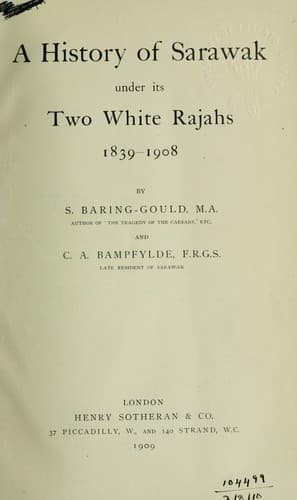
A History of Sarawak under Its Two White Rajahs 1839-1908Baring-Gould, S. (Sabine)
History
A History of Sarawak under Its Two White Rajahs 1839-1908
Baring-Gould, S. (Sabine)
Charles, Rajah of Sarawak, 1829-1917; James, Rajah of Sarawak, 1803-1868; Sarawak (Malaysia) -- History
A few words may be said here with regard to the situation generally, and
the attitude of the population. From Muka, the Sherip Masahor, the
friend and connection of Pangiran Nipa, could look for strong support.
In the Rejang he had on his side the Kanowits, the Banyoks, and the
Segalangs, the last a hot-headed and treacherous people, who had always
been the Sherip's most active partisans, and were afterwards his only
sympathists; upon the Dayaks it was naturally thought he could count,
but, as regards those of the Kanowit, events proved this to be a
mistake; amongst the Melanaus of the delta he had a strong following at
Igan, Matu, and Bruit, but not at the other villages; and the Malays of
Serikei feared and obeyed him, though from their chiefs downwards they
hated him. The Kalaka Malays, under a bad leader, were very doubtful.
Those in Saribas were held in check by the Dayaks, who had been
converted by the Tuan Muda from stout enemies into staunch friends; the
Sea-Dayaks generally were as true as steel to their white chief, though
some were led astray. The Sekrang Malays were faithful, but the Lingga
Malays had allowed themselves to be awed by letters that had been sent
them by the conspirators, calling upon them to assist in killing the
English or to expect the consequences. Though they received these
letters they made no response to the overtures, and were at heart with
the Government. Sadong, where there had been no English officer for some
time, was, under the Bandar Kasim, a hotbed of anarchy, and here were
the Datu Haji's principal adherents, as also were the Land-Dayaks of
Lundu.
In Kuching and its neighbourhood the Malays were as usual loyal, from
their Datus, the Bandar, Imaum (whose sister the Datu Haji had married)
and the old fighting Temanggong downwards. Here the Datu Haji had a
small clique only, but men's minds were becoming disturbed by the
baneful rumours that were being sedulously spread about of the impending
downfall of the Government. It was brought home to their minds, and
insisted on, that the Rajah had forfeited the confidence of the British
Government, which was prepared to leave him to his fate. No more
men-of-war had been sent to Sarawak, and no help had been offered the
Rajah for the suppression of the Chinese insurrection; all this
exercised a bad influence on some who wavered, though at heart loyal,
and it discouraged the faint-hearted, just as it encouraged hopes in the
disaffected Malay chiefs and the Sherips that they might recover their
lost supremacy. Any signal reverse to the Government, or any indecision
shown by it, would have produced the gravest consequences, which must
have resulted, however the issue went, in the ruin of the country. The
crisis was critical, and without a strong man at the helm, disaster
would have followed—a leader to counterbalance the influence of the
conspirators—a leader for the loyal to rally around and to inspire the
timid, was wanted, and was at hand.
Public-domain text, read in full here on John Shaqi.
Reviews
Reviews
No reviews yet
Be the first to share your thoughts on this work.
Elsewhere in the archive