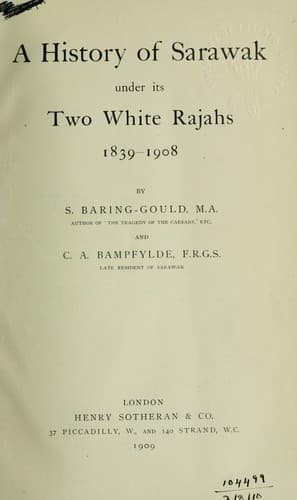
A History of Sarawak under Its Two White Rajahs 1839-1908Baring-Gould, S. (Sabine)
History
A History of Sarawak under Its Two White Rajahs 1839-1908
Baring-Gould, S. (Sabine)
Charles, Rajah of Sarawak, 1829-1917; James, Rajah of Sarawak, 1803-1868; Sarawak (Malaysia) -- History
Rightly conjecturing that he might be making for the Kapuas, the Tuan
Muda despatched one party under Mr. Hay to the head of the Sadong by the
Sarawak river to prevent this, and an express was sent by Sherip
Matusain to warn the Dutch officials. Though Mr. Hay pressed on, he was
too late to intercept this pseudo prince, who had crossed the border,
two days before he arrived, at the head of a strong following of Malays
and Dayaks. In regal style this _prince_ was borne in a litter, as
became one of his exalted rank, and he now styled himself Sultan.
Everywhere he was treated with marked respect. Men gladly enrolled
themselves in his service, and accorded him the large contributions in
goods and slaves that he exacted. It was arranged that the chiefs over
the border—of Landak, Sanggau, and Pontianak—were to rise along with
their people under his command against the Dutch; and, indeed, it is
probable that many might have done so, for at Sanggau he was received
with salutes and all honours. But the rôle of a prince was to be
speedily changed for the more fitting one of a malefactor in chains. The
Dutch acted promptly, and one fine morning he found the place invested
by troops, and the house in which he was staying surrounded. Some of his
supporters appear to have flown to his aid, for one pangiran was killed
and another wounded—these were genuine pangirans. The impostor
surrendered, was placed in irons, and conveyed to prison in Batavia;
here he was soon joined by the Datu Haji in the same unhappy plight. The
latter had gone to Pontianak to carry out the part assigned to him, and
had unwittingly run into a trap, for on landing he was immediately
arrested. His departure from Singapore was known to Mr. Grant, who was
then at that place, and reported by him to the Dutch Consul there, who
immediately telegraphed the news to Batavia.
The countries Tunjang had passed through were in a most unsettled state,
and the minds of the people were over-filled with false reports. Some of
the head men were prepared to live, and, if needs be, die in support of
the mock Temanggong. Sadong was in revolt, and the Bandar Kasim had sent
an open defiance to Kuching. It was now known that Sherip Masahor was,
and had been from the first, the leading spirit of the conspiracy, and
Tunjang had confessed as much to the Dutch.[247]
Public-domain text, read in full here on John Shaqi.
Reviews
Reviews
No reviews yet
Be the first to share your thoughts on this work.
Elsewhere in the archive
Join the Discussion
Join the discussion
Sign in to leave a comment or review.
Sign InorCreate an account