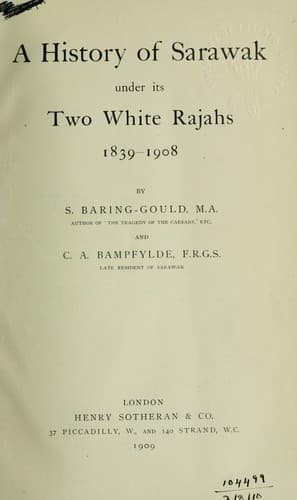
A History of Sarawak under Its Two White Rajahs 1839-1908Baring-Gould, S. (Sabine)
History
A History of Sarawak under Its Two White Rajahs 1839-1908
Baring-Gould, S. (Sabine)
Charles, Rajah of Sarawak, 1829-1917; James, Rajah of Sarawak, 1803-1868; Sarawak (Malaysia) -- History
The Rajah then went to Muka with a large force to ensure that there
should be no resistance, and Muka was surrendered to him. Pangiran Nipa
and the Bruni aristocracy were sent to Bruni, and Sherip Masahor was
deported to Singapore. The Rajah wrote: "He will never trouble Sarawak
more, and I am not lover enough of bloody justice to begrudge him his
life on that condition. He deserved death, but he was a murderer for
political ends."
The Rajah now established himself at Muka, and spent a month working to
bring order into the district, so torn by civil war and crushed by
oppression that everything was in confusion, and where there had been no
protection for either person or property, and justice had not been
administered. The effect of opening the port was immediate. Numbers of
vessels entered bringing goods from Kuching to traffic with the natives
for raw sago.
Early in August the Rajah went to Bruni again, and for the last time.
The concession to Sarawak of the coast and districts from the Rejang to
Kedurong point was then completed. For many years the Sultan had derived
little or no revenue from these parts, for what had been squeezed out of
the natives by the pangirans went to fill their own pockets, and he was
more than satisfied to receive a sum down and an annual subsidy, which
would be paid into his own hands. And the natives rejoiced, for they
were now freed from the rapacity of these Bruni pangirans.
"And thus," says the Tuan Muda, "were about 110 miles of coast annexed
to the Sarawak territory—valuable for the sago forests, but in a most
disturbed state, owing to a prolonged period of the worst anarchy and
misgovernment. Its inhabitants had many redeeming qualities when once
relieved from the Bruni tyranny and oppression, as they were industrious
and clever in different trades, particularly that of working wood, and
the rougher kinds of jungle labour. But they required a severe hand over
them, although one that was just, and were scarcely able to appreciate
kindness. They had considered it a merit to a certain extent to be the
Sultan's slaves, although they had many times smarted under the foulest
injustice, and been deprived of their wives and daughters; the majority
of the latter class were often taken for the Bruni Rajahs' harems.
"The women were considered better looking than most others on the coast,
having agreeable countenances, with the dark open rolling eye of
Italians. The men are cleanly and generally well dressed, but not so
nice looking as those of many other tribes."
After the Rajah had laid the foundations of good government, he
appointed Mr. Hay as Resident,[268] and in a few years the aspect of the
place, the condition of the people, and even their character was changed
for the better. A fort had also been planted at Bintulu, then at the
extreme north of the coast now under the sway of the Rajah, and a
Resident appointed there.
Public-domain text, read in full here on John Shaqi.
Reviews
Reviews
No reviews yet
Be the first to share your thoughts on this work.
Elsewhere in the archive
Join the Discussion
Join the discussion
Sign in to leave a comment or review.
Sign InorCreate an account