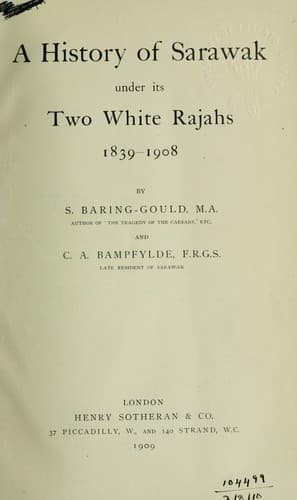
A History of Sarawak under Its Two White Rajahs 1839-1908Baring-Gould, S. (Sabine)
History
A History of Sarawak under Its Two White Rajahs 1839-1908
Baring-Gould, S. (Sabine)
Charles, Rajah of Sarawak, 1829-1917; James, Rajah of Sarawak, 1803-1868; Sarawak (Malaysia) -- History
The prisoners, with the exception of the lads, were all executed. The
lads were put to work on the gunboats, and became excellent and
trustworthy sailors—one, who was the son of a Lanun of rank,
subsequently commanded the present Rajah's former yacht the _Aline_.
Some of the captives were Dutch subjects, and some were British subjects
from Singapore. In the captured pirate prahu there were found five Dutch
and one Spanish ensign.
Sailing along past the delta of the Rejang, when off the pretty little
village of Palo, which was hidden from their view, the pirates had
observed a long canoe laden with nipah palm leaves, with a man in the
stern and a woman in the bows, paddling for dear life to escape. A light
canoe manned by half-a-dozen men was at once despatched in chase, and
quickly overhauled the poor couple, the man crying out that he
surrendered, and the woman screaming with fear. It was a pretty example
of the biter bit—a neatly contrived trap. Gliding alongside to secure
their apparently helpless captives, without troubling to exchange
paddles for weapons, to their amazement the pirates saw an upheaval of
the leaves and several armed men spring up, together with the steersman
and the disguised man in the bows. This startling development took the
pirates so completely by surprise that they were all speared before they
could seize their weapons. The Melanaus then quickly disappeared up a
creek. Their leader was the late Atoh, a young man then, who afterwards
became the Government chief of Palo. He is perhaps better known to the
present generation as Haji Abdul Rahman.
The following translation of a paper written by a Nakoda Amzah, one of
the rescued captives, and found amongst his papers after his death,
gives a good account of the voyage of this fleet, and of its
destruction. He was a Kampar (Sumatra) Malay, who lived in Sarawak since
his rescue. He, his grandson, and another Malay were killed in the
Rejang in 1880 by a head-hunting party of Dayaks. He was noted for his
courage. He had been twice before captured by pirates. In this
translation the word "pirate" is substituted for Bajau, Lanun, and
Balanini, which the writer uses indiscriminately, and no doubt the crews
of the piratical prahus were an admixture of these tribes.
Public-domain text, read in full here on John Shaqi.
Reviews
Reviews
No reviews yet
Be the first to share your thoughts on this work.
Elsewhere in the archive
Join the Discussion
Join the discussion
Sign in to leave a comment or review.
Sign InorCreate an account