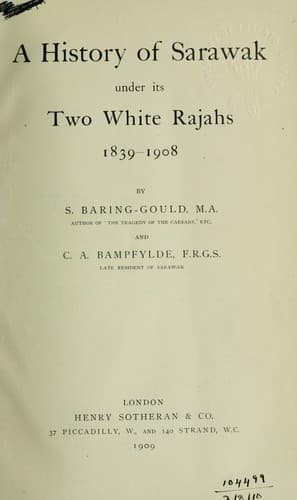
A History of Sarawak under Its Two White Rajahs 1839-1908Baring-Gould, S. (Sabine)
History
A History of Sarawak under Its Two White Rajahs 1839-1908
Baring-Gould, S. (Sabine)
Charles, Rajah of Sarawak, 1829-1917; James, Rajah of Sarawak, 1803-1868; Sarawak (Malaysia) -- History
Before his return to England the Rajah heard that recognition had been
granted, though he was not officially notified of the fact until his
arrival there. It was full and complete; and a Consul was appointed to
Sarawak for whom an _exequatur_ was asked of the Rajah.[278] The Rajah's
forethought, which we have already recorded, that "time brings changes,
and may work on the British Government" was thus fully justified. The
Duke of Newcastle, Lords Palmerston and John Russell, Sir G. Grey, the
Honble. Sidney Herbert, and Mr. Gladstone had been members of the
Cabinet that issued the Commission, as they were now members of the
Cabinet that granted the long refused recognition.
The Tuan Muda had accompanied the Rajah from England. He had assumed the
surname of Brooke by the desire of his uncle, and this had been decided
upon before the defection of his brother had been known. The Rajah
desired it because it was the name of the ruling family, and it would
remove confusion and ambiguity, and place his nephew in a clearer
position before the world. The Tuan Muda refused to take the title of
Rajah Muda, or to be formally recognised as his uncle's heir, trusting
that his brother might pave the way to reconciliation and to his
reinstatement.[279]
Whilst the Rajah remained at Kuching to restore order, and to introduce
proper systems into the various departments, the Tuan Muda returned to
Sekrang, where he was received with many demonstrations of good feeling.
The population turned out and towed and escorted his pinnace up the
river, and salutes were fired wherever he passed. But they were not more
glad to welcome him, than he was to see them. He then visited all the
out-stations as far as Bintulu. Muka he found prosperous, and the people
happy. He then returned to Sekrang to prepare for the expedition against
the Kayans.
This powerful tribe has already been spoken of as living far inland on
the head-waters of the Rejang. They were a continual trouble to the
Dayaks who lived on that same river, but lower down, raiding their
country, taking heads, and making captives, whom they tortured to death.
Their country was not easily accessible, on account of the rapids in the
river. The first rapids on the Rejang are about 170 miles from the
mouth; these passed, the river is navigable for sixty miles, then ensue
further rapids for about five miles, and then again it is navigable for
fifty more. The upper rapids, called those of Makun, are the most
serious and difficult to overcome, so serious, indeed, that the Kayans
did not suppose it possible that an enemy could ascend above them.
Public-domain text, read in full here on John Shaqi.
Reviews
Reviews
No reviews yet
Be the first to share your thoughts on this work.
Elsewhere in the archive
Join the Discussion
Join the discussion
Sign in to leave a comment or review.
Sign InorCreate an account