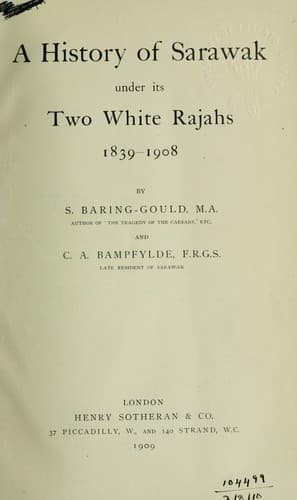
A History of Sarawak under Its Two White Rajahs 1839-1908Baring-Gould, S. (Sabine)
History
A History of Sarawak under Its Two White Rajahs 1839-1908
Baring-Gould, S. (Sabine)
Charles, Rajah of Sarawak, 1829-1917; James, Rajah of Sarawak, 1803-1868; Sarawak (Malaysia) -- History
Sir Spenser must have trusted to his memory, which played him false. The
Sarawak Government had then another and a larger steamer, the
_Heartsease_,[293] and the Rajah was having the _Royalist_[294] built in
England to carry mails and merchandise to and from Singapore. He was
consulted about the sale of the _Rainbow_ and sanctioned it, for he
wrote to the Tuan Muda on March 6, 1865, "We are quite agreed as to the
advisability of selling the _Rainbow_," the purchase money to go towards
paying for the new vessel he was having built. The Singapore agents were
instructed to remit the money home, but, without the knowledge of the
Tuan Muda, kept it to cover an over-draft. This over-draft was not
incurred to pay expenses of public works, but for absolute necessaries.
The Rajah had but little trouble to raise the balance due on the
_Royalist_; and even this was not necessary, for a Singapore Bank at
once advanced an amount equivalent to the balance due on the _Rainbow_,
which was remitted to England.
At Burrator, his little out-of-the-world Devonshire seat, on the edge of
the moors, the Rajah was perfectly happy so long as not troubled with
bad news from Sarawak. He devoted himself to the country-side folk, who
were greatly attached to him. His life was one simple and contented; he
enjoyed the exceeding quietude, and he was happy in trying to make
others happy. Riding and shooting, so long as his health permitted, were
his amusements, parish affairs, and the improvement of his little
property, his chief interests.
The longing to return to his people was strong upon him. But, as time
advanced and his strength diminished, he foresaw that what had become
the desire of his life would be denied him. Some three years before his
death he wrote to the Tuan Muda, "Farewell, think of me as well content,
free from anxiety, and watching your progress with pride and pleasure."
Largely assisted by the late Sir Massey Lopes, who owned the land in the
parish, he "restored" the Parish Church, and was instrumental in a new
school being provided. The church contained a magnificent rood-screen,
richly carved and gilt, extending across the nave and aisle; indeed it
was the finest specimen in that part of the county. Unhappily neither
the Rajah nor Sir Massey could appreciate its artistic and antiquarian
value, and it was ruthlessly swept away. No architect was employed, only
a local builder, and the new work done in the church is as bad as can be
conceived, such as was likely to proceed from the designs of a common
ignorant builder.
On June 11, 1868, Sir James Brooke died at Burrator, leaving the
succession of the raj to his nephew Charles Brooke, and his male issue,
failing such to his nephew H. Stuart Johnson and his male issue. In
default of such issue, the Rajah devised his said sovereignty, "The
rights, privileges, and power thereto belonging, unto her Majesty the
Queen of England, her heirs and assigns for ever."
Public-domain text, read in full here on John Shaqi.
Reviews
Reviews
No reviews yet
Be the first to share your thoughts on this work.
Elsewhere in the archive
Join the Discussion
Join the discussion
Sign in to leave a comment or review.
Sign InorCreate an account