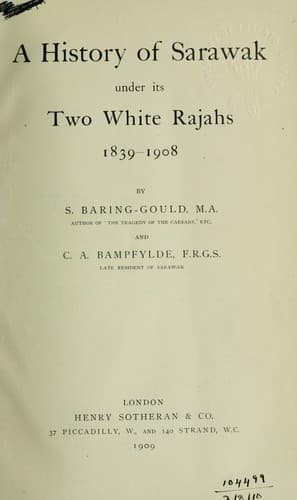
A History of Sarawak under Its Two White Rajahs 1839-1908Baring-Gould, S. (Sabine)
History
A History of Sarawak under Its Two White Rajahs 1839-1908
Baring-Gould, S. (Sabine)
Charles, Rajah of Sarawak, 1829-1917; James, Rajah of Sarawak, 1803-1868; Sarawak (Malaysia) -- History
How deserved this trust was, has been made manifest by the present
Rajah's own life-long devotion to the interests of the people he was
ordained to govern. On his accession, no change was made in the wise and
liberal policy of his predecessor. Only such reforms and improvements,
administrative or otherwise, consistent with that policy have been made.
Up to the time of the first Rajah's death, no great progress
commercially and financially had been effected, and it was left to his
successor to promote the commercial and industrial advancement of the
State. The Sea-Dayaks and tribes of the interior still required a strong
hand and a watchful eye to keep them in order, and the subsequent large
additions of territory entailed greater responsibility and harder work.
In the gradual establishment of a government suitable to the country and
its people, the main principles that have guided the late and the
present Rajah are—that the natives should, through their chiefs, have a
full though subordinate share in its administration and its councils;
that their own laws and customs should be respected, though modified
where necessary in accordance with the first principles of justice and
humanity. That no sudden and wholesale changes disquieting to the native
mind should be made, and that reforms should be very carefully
considered from both the white man's and the native's point of view
before being introduced, and that if carried out, it should be done
gradually. Thus, without giving rise to any opposition or discontent,
slavery, which was at one time in a cruel and oppressive form, by a
gradual process of ameliorating the condition of the slaves, enlarging
their privileges, reducing the powers of owners and increasing their
responsibilities, in course of time ceased to be a profitable
institution, and died a natural death without any sudden and violent
legislation.
How that was done will be shown in the following chapter.
Among the Spartans a drunken helot was produced, staggering and
imbecile, to show the young into what a disgraceful condition a man fell
who gave way to liquor. And in Borneo, in the Sultanate of Bruni, the
people had before their eyes a reminder of what was a bad, irresponsible
government.
The old Rajah left behind him one of the noblest records of a life
devoted to the cause of humanity, and of a task completed, which has
been equalled by few men. His motives, untarnished by any desire for
honours or for worldly advancement, were as pure as was his chivalry,
which was without reproach. No better man, and few greater, have lived.
Public-domain text, read in full here on John Shaqi.
Reviews
Reviews
No reviews yet
Be the first to share your thoughts on this work.
Elsewhere in the archive
Join the Discussion
Join the discussion
Sign in to leave a comment or review.
Sign InorCreate an account