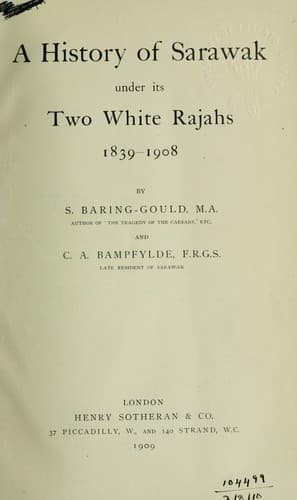
A History of Sarawak under Its Two White Rajahs 1839-1908Baring-Gould, S. (Sabine)
History
A History of Sarawak under Its Two White Rajahs 1839-1908
Baring-Gould, S. (Sabine)
Charles, Rajah of Sarawak, 1829-1917; James, Rajah of Sarawak, 1803-1868; Sarawak (Malaysia) -- History
In June, 1887, Sir Frederick Weld, Governor of Singapore, went to Bruni
to settle a dispute between the North Borneo Company and the Sultan over
a debateable strip of land. Sultan Hasim seized the occasion to pour
into the ear of Sir Frederick a tissue of accusations against Sarawak,
and no Sarawak official was allowed to be present to refute them. The
Government of the Rajah was charged with disturbing the peace, and with
sending its emissaries into the Limbang to foster discontent, and to
keep the rebellion simmering, in the hopes of being able to find an
excuse for annexing the district. Sir Frederick listened, but apparently
believed little he heard, for he recommended the Sultan to hand over the
Limbang to the Rajah. He further strongly urged the Sultan to accept a
British Protectorate over his remaining dominions, and to receive a
Resident, who might act as adviser in the administration of the State.
The Sultan consented to this latter recommendation; his intention,
however, to accept a British Resident at Bruni, to prevent his misrule,
and to curb the tyranny of his adherents, was only pretence. Sir
Frederick Weld was perhaps acting beyond his instructions in proposing
the appointment of a Resident, but the proposal was sound. In September,
1888, the late Sir Hugh Low, then Resident of Perak, was despatched to
Bruni to conclude an agreement with the Sultan by which Bruni became a
Protectorate.
In the Federated Malay States, as in the Indian Protectorates, British
Residents are placed who can advise as to the conduct of government, and
it is perfectly understood by the native rulers that their advice must
be followed. Now, a British Protectorate had been extended over Bruni,
and as a consequence a Resident should have been placed there to control
the Sultan and check the misdoings of his chiefs. But nothing of the
sort was done. The Limbang was left in a condition of disorder, and a
menace to its neighbours, and the Brunis to the arbitrary injustice and
cruelty of their rulers. Trusan now offered a near haven of refuge to
which many fled, both slaves and free-born people, the latter chiefly to
save their daughters from a fate worse than slavery—a short period in a
harem, and then domestic drudgery for life. The British Government would
do nothing, and looked very much as if it were not disposed to allow any
one else to do anything. Sir Hugh Low,[316] who had an exceptional
experience of Bruni and the people, had urged the Sultan to place the
Limbang under the Rajah, tendering the same advice as had Sir Frederick
Weld; but to this, also, Hasim turned a deaf ear.
Public-domain text, read in full here on John Shaqi.
Reviews
Reviews
No reviews yet
Be the first to share your thoughts on this work.
Elsewhere in the archive
Join the Discussion
Join the discussion
Sign in to leave a comment or review.
Sign InorCreate an account