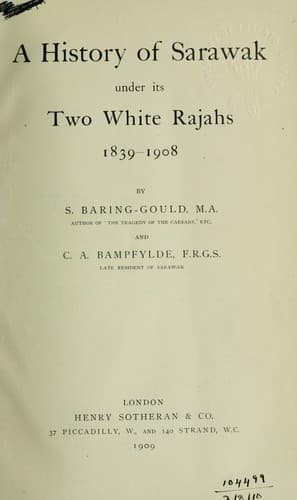
A History of Sarawak under Its Two White Rajahs 1839-1908Baring-Gould, S. (Sabine)
History
A History of Sarawak under Its Two White Rajahs 1839-1908
Baring-Gould, S. (Sabine)
Charles, Rajah of Sarawak, 1829-1917; James, Rajah of Sarawak, 1803-1868; Sarawak (Malaysia) -- History
Formerly of the Royal Navy, and the Labuan Civil Service. Joined the
Sarawak Civil Service 1871. Was Resident at Muka, and subsequently
Divisional Resident of the 3rd Division. Died 1884.
Footnote 309:
St John's _Forests of the Far East_.
Footnote 310:
It will be remembered that in 1849 the late Rajah, as her Majesty's
Commissioner, had concluded a treaty with the Sultan of Sulu, but this
had to be ratified within two years. The British Government, however,
would not place a man-of-war at the Rajah's disposal, and he was
unable to proceed to Sulu to effect this necessary ratification. The
Spaniards, by force of arms, enforced another treaty upon Sulu, and
before those two years had expired. But the British Government took no
interest in Sulu, and this was allowed to pass unheeded.
Footnote 311:
He had succeeded Mr. Pope Hennessy, and was Mr. Ussher's predecessor.
Footnote 312:
Named after the late Mr. C. A. C. de Crespigny.
Footnote 313:
In a great degree due to the able administration of Mr. Charles Hose,
D.Sc., who served in this district for twenty years, during sixteen of
which he was Resident in charge. In 1904 he became Divisional Resident
of the 3rd Division; he retired in 1907.
Footnote 314:
Joined 1872; was Assistant Resident, and Resident of Batang Lupar and
Saribas, and in 1881 became Divisional Resident of Sarawak proper. He
retired in 1895, and died in 1897.
Footnote 315:
See footnote, p. 69.
Footnote 316:
Sir Hugh Low, G.C.M.G., who was then British Resident of Perak, had
for many years been Colonial Secretary at Labuan.
Footnote 317:
These had long ceased.
Footnote 318:
Mr. Ricketts, who is a son of the first British Consul to Sarawak,
joined in 1881.
Footnote 319:
Now Managing Director of the British North Borneo Company.
Footnote 320:
For this reason a large number of Malays, men, women, and children, in
April, 1904, moved into the Limbang. The men were the ironsmiths of
Bruni, and this useful class was forced to leave to save their girls.
And because some of their women had been seized and sold, the Kadayans
of Bruni, who in former days had been the faithful followers of the
Sultans and their main support, revolted in 1899.
Footnote 321:
Two years previously a Sarawak Chinaman was murdered in the Belait,
and that this was done at the instigation of an Orang Kaya, solely in
the expectation that the murder of a Sarawak subject would lead to
such active interference by the Government of that country in the
affairs of the district that might end in annexation, was proved in a
Court of inquiry held at Claudetown.
Footnote 322:
Many of the peaceable Kadayans removed into the Limbang, having been
driven from their homes, with the loss of all their property, by an
emissary of the Sultan, for refusing to join him in an attack on the
rebels.
Footnote 323:
Sarawak and British North Borneo.
Footnote 324:
Public-domain text, read in full here on John Shaqi.
Reviews
Reviews
No reviews yet
Be the first to share your thoughts on this work.
Elsewhere in the archive
Join the Discussion
Join the discussion
Sign in to leave a comment or review.
Sign InorCreate an account