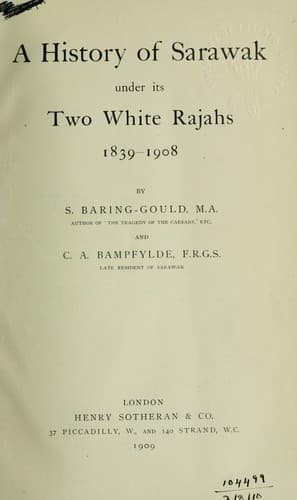
A History of Sarawak under Its Two White Rajahs 1839-1908Baring-Gould, S. (Sabine)
History
A History of Sarawak under Its Two White Rajahs 1839-1908
Baring-Gould, S. (Sabine)
Charles, Rajah of Sarawak, 1829-1917; James, Rajah of Sarawak, 1803-1868; Sarawak (Malaysia) -- History
Having satisfied himself as to the character of the Saribas and Sekrang
Dayaks, and how the chiefs governing them encouraged their depredations,
and having received an appeal from the Rajah Muda Hasim[114] to relieve
the cost of the perils it underwent, Captain Keppel resolved to attack
the Saribas first, as being the most formidable of the two piratical
hordes.
Preparations for the expedition were soon commenced. It was to consist
of a native force of 300 Malays, the _Dido's_ three large boats, and the
_Jolly Bachelor_, manned by blue-jackets and marines, all under the
command of Lieutenant Wilmot Horton. The datus were opposed to the Rajah
going—they thought the risk too great, but on his expressing his
determination to do so, and leaving it to them to accompany him or not,
their simple reply was, "What is the use of our remaining? If you die,
we die; and if you live, we live; we will go with you."[115] The Rajah
and Captain Keppel accompanied the expedition in the _Dido's_ gig.
Intelligence of the design was carried far and wide. The Saribas
strengthened their defences, and several of the half-bred Arab sherips
living nearer Sarawak sent in promises of good conduct. Tribes that had
suffered from the depredations of the pirates offered to join in
attacking them, and the force thus augmented by several hundreds of
Dayaks started early in June.
The first skirmish fell to the lot of Datu Patinggi Ali, who, having
been sent on ahead, met a force of seven prahus at the mouth of the
Saribas, which he attacked and drove back, after capturing one. Padi, a
stockaded town some 60 miles up the Saribas river, and the furthest up
of the piratical strongholds, reputed also to be the strongest and most
important, was the first attacked, and though defended by two forts and
two booms of forest trees stretched across the river, and being crowded
with Malay and Dayak warriors, it was carried on the evening of June 11,
and the place committed to the flames. The next day some 800 Balau
Dayaks,[116] under Sherip Japar of Lingga, joined the force, keen to
make reprisals for past injuries.
Public-domain text, read in full here on John Shaqi.
Reviews
Reviews
No reviews yet
Be the first to share your thoughts on this work.
Elsewhere in the archive
Join the Discussion
Join the discussion
Sign in to leave a comment or review.
Sign InorCreate an account