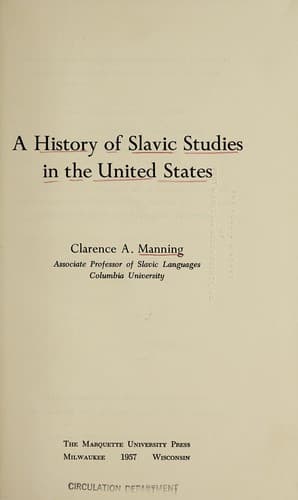
A history of Slavic studies in the United StatesManning, Clarence Augustus
History
A history of Slavic studies in the United States
Manning, Clarence Augustus
Slavic philology -- Study and teaching; Slavs -- History -- Study and teaching
The situation at Columbia University was different. Professor Clarence
A. Manning, who was acting department head during the twelve years which
Professor Prince spent in the American diplomatic service, tried to
continue the policy of Professor Prince in fostering a study of all the
Slavic languages and in establishing contacts with the Slavic
communities in the New York area. In terms of administration, the chief
development was the transfer of most instruction in the Slavic languages
from the faculty of philosophy, where it had originated, to the Columbia
Extension Teaching, later revamped as the School of General Studies.
This school had been planned originally for adult education but as it
acquired a special form it furnished a convenient vehicle for many
years, for giving language instruction. For some years it conducted a
series of extramural courses, especially in Polish, as far away as
Wilkes-Barre, Pennsylvania.
The first addition to what eventually became a full time staff was Mrs.
Elena T. Mogilat who, from 1922 until the eve of World War II, conducted
practically all the courses in the Russian language. In 1927, Arthur P.
Coleman, the first American of non-Slavic origin to receive a doctorate
in Slavic languages in the United States, was appointed Lecturer and
devoted himself chiefly to courses in Polish.
The rest of the staff, some of whom served for many years, was composed
chiefly of educated journalists employed on the Slavic papers in New
York or persons occupying responsible positions in various institutions
of learning and business. Almost without interruption, yearly courses
were given in Polish, Czechoslovak and Serbo-Croatian or Slovene. We
must specifically mention the courses in Albanian given by Nelo Drizari
who published, at this period, an Albanian-English grammar and a small
Albanian-English dictionary. Most of the students in these non-Russian
courses were second generation Slavs. Few of these ever worked toward
higher degrees.
During the twenties, most students for the doctorate were Russians or
persons of Russian descent who had come to the United States after the
Revolution seeking positions in the American educational world. Those
who took the master’s degree were largely of the second generation or of
non-Slavic origin.
Public-domain text, read in full here on John Shaqi.
Reviews
Reviews
No reviews yet
Be the first to share your thoughts on this work.
Join the Discussion
Join the discussion
Sign in to leave a comment or review.
Sign InorCreate an account