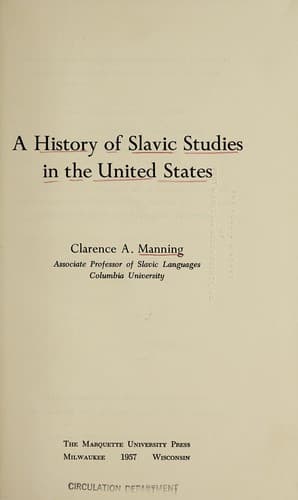
A history of Slavic studies in the United StatesManning, Clarence Augustus
History
A history of Slavic studies in the United States
Manning, Clarence Augustus
Slavic philology -- Study and teaching; Slavs -- History -- Study and teaching
The department made its most extensive efforts in 1929 in providing a
summer course on the history of all Slavic literatures. The lectures on
Russian were given by Prince D. S. Mirsky of the University of London;
on Czech, by Professor Otakar Vocadlo; on Polish, by Professor Kelly of
Dartmouth; and, on Yugoslav, by Dr. D. Subotic of the University of
London. One lecture on Bulgarian was prepared by Dimitar Shishmanov, the
son of the distinguished professor of Slavic philology at the University
of Sofia and a well-known Bulgarian author who was executed by the
Communists after World War II. The response of students was not
sufficient to justify the repetition of the experiment in the next
years, although the numbers exceeded anything achieved in England at
that time for similar programs.
At the time it was the idea of Professor Manning that the future of
Slavic studies, especially in those languages spoken by considerable
communities in the United States, lay in the development of interest and
support from those communities. This notion was, at the time, warmly
supported by Columbia’s President Nicholas Murray Butler and led to the
formation of an Institute of Polish Culture and an Institute of
Czechoslovak Studies. Both met with initial success but the depression
with its pressure upon the Slavic population of the United States, led
to a practical suspension of the institutes after the publication of a
Polish number of the American archaeological journal, _Art and
Archaeology_, and a translated _Anthology of Czechoslovak Poetry_
compiled in the United States and Canada.
On the return of Professor Prince in 1933, the name of the department
was changed to East European Languages and Professor Prince made a new
effort to realize his dream of founding something that would include all
of the peoples of Eastern Europe. It proved premature, once again. The
department underwent further change after the retirement of Professor
Prince. Then in the fall of 1938, Professor Max Vasmer of the University
of Berlin lectured for one semester; he was followed by Professor Boris
Unbegaun of the University of Strassburg. Still later Professor Karl
Menges was added to the faculty to give courses in Slavic and Altaic
philology.
In still a different field, Professor Manning and Dean Hawkes, of
Columbia College, were both active in the establishment of St.
Vladimir’s Russian Orthodox Seminary in New York, to train candidates
for the priesthood of the Russian Orthodox Church of North America. This
developed later into St. Vladimir’s Orthodox Seminary and Theological
Academy. To this were invited many of the leading emigrant Russian
theologians from Paris and elsewhere.
Public-domain text, read in full here on John Shaqi.
Reviews
Reviews
No reviews yet
Be the first to share your thoughts on this work.
Join the Discussion
Join the discussion
Sign in to leave a comment or review.
Sign InorCreate an account