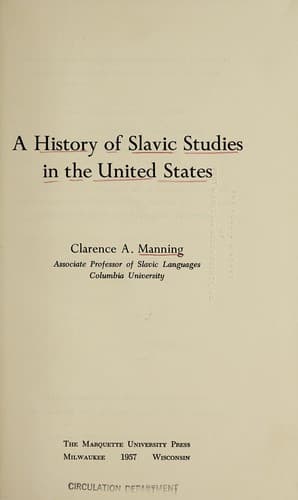
A history of Slavic studies in the United StatesManning, Clarence Augustus
History
A history of Slavic studies in the United States
Manning, Clarence Augustus
Slavic philology -- Study and teaching; Slavs -- History -- Study and teaching
The development at Harvard was somewhat different. Few changes were made
in the situation which existed prior to World War I, until the
retirement of Professor Wiener. Then in 1927 Professor Samuel Hazzard
Cross (born in 1891, A.B. and Ph.D. at Harvard before 1917), rejoined
his alma mater and after some years of service in the German department
was made, in 1930, Professor of Slavic Languages. With the appointment
of Professor Cross, Slavic work at Harvard went through a new period of
development and expansion. Into the revised department Cross brought
Professor Ernest J. Simmons who had taken his doctorate in 1928 with a
study of English influence on Russian literature of the eighteenth
century. A larger staff of Russian assistants was also engaged.
Professor Cross, who had translated the _Russian Primary Chronicle_,
stressed the older period of Russian literature, perhaps because of his
Germanic interests. He also became the managing editor of _Speculum_,
the organ of the Mediaeval Academy of America. In his interest in the
medieval period, Professor Cross was not alone in Harvard for from the
School of Architecture came the work of Professor Kenneth J. Conant on
St. Sofia Cathedral in Kiev and from the English department the work by
Francis P. Magoun, Jr. on the spreading in East Slavic lands of the
medieval _gestes_ of Alexander.
During the following years, Professor Cross became the center of the
developing Slavic activity, which was not limited to Harvard, but which
was responsible for the publication of various works in connection with
the Pushkin Centennial in 1937. The death of Cross in 1946 was a great
loss to American-Russian scholarship.
Still another attempt to promote Slavic studies was made at the
University of Pittsburgh by the establishment of national rooms in the
Cathedral of Learning to serve as centers for the national interests of
the students. The Slavic communities, in and around the city, were urged
to provide funds to furnish these rooms in native style and appeals were
frequently made to the governments of the Slavic countries to help in
the work.
In 1927 also, Professor Michael Karpovich, joined the faculty at Harvard
as Professor of Russian History. Professor Karpovich had been trained as
a lawyer and diplomat in Russia before the Revolution of 1917 and he
soon became a leading spokesman for the Russian liberal groups in the
United States and in America’s scholarly communities.
At the end of World War I, it was proposed that a scientific society be
established to unite Slavic scholars. The constitution and practice of
existing organizations in history seemed sufficiently broad to include
the professors of those subjects but a more complicated situation
prevailed in the fields of language and literature.
Public-domain text, read in full here on John Shaqi.
Reviews
Reviews
No reviews yet
Be the first to share your thoughts on this work.
Join the Discussion
Join the discussion
Sign in to leave a comment or review.
Sign InorCreate an account