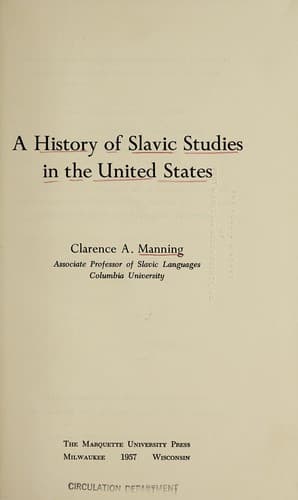
A history of Slavic studies in the United StatesManning, Clarence Augustus
History
A history of Slavic studies in the United States
Manning, Clarence Augustus
Slavic philology -- Study and teaching; Slavs -- History -- Study and teaching
The Columbia collections were increased by the gift of a large library
on Russian literature, collected for many years by Dr. Samuel Abel, a
graduate of the College of Physicians and Surgeons. It numbered several
thousand volumes. The establishment of the Hoover War Library at
Stanford University brought to that institution a vast amount of
material, especially concerning Slavic countries, that had been
collected by American Relief workers, under the direction of Herbert
Hoover.
We must also mention the work that developed at Georgetown University
under the direction of Father Edmund Walsh who had served in Russia
after the Revolution. Work was done in the various schools but
especially in the School for Foreign Service of which Father Walsh was
the founder. Georgetown’s example was seconded by the continual
improvement in the standards of other institutions such as that of the
Czech Benedictines at Lisle, Illinois, and further, by the
establishment, in 1933, of such institutions as St. Basil’s College in
Stamford, Connecticut, by the Ukrainian Greek Catholic Exarchate of
Philadelphia.
There was also a large number of Slavic books and translations from
Slavic in the public library in Cleveland, Ohio, where Mrs. Eleanor
Ledbetter had worked long and hard with the Slavic groups in that city.
Thus, by the outbreak of World War II, there were in the United States a
considerable number of libraries that were fairly adequate in nearly all
the centers where Slavic subjects were treated with the importance that
they deserved.
In 1931 work in Russian literature in English was also started at the
University of Washington, in Seattle, by Ivar Spector. In 1943, a course
in Russian history was added. In addition to these courses, Professor
Spector did considerable lecturing before various groups interested in
Russian affairs. The interest in Seattle is especially noticeable
because of the possible contacts with Siberia across the Pacific Ocean.
Whatever contact is had with the Soviet Union comes almost inevitably
through the seacoast cities on the Pacific Ocean. The same motives have
led to a strengthening of Russian work in the other California
universities, the University of California at Los Angeles and the
University of Southern California.
Strange to say, the recognition of the Soviet Union in 1933 by the
United States did not produce a marked increase in interest in Russian
Slavic affairs. Student interest flagged and it was soon evident that
the need for Russian in the business world would not at all parallel the
situation which a few years earlier had sparked the great development in
Spanish studies.
Public-domain text, read in full here on John Shaqi.
Reviews
Reviews
No reviews yet
Be the first to share your thoughts on this work.
Join the Discussion
Join the discussion
Sign in to leave a comment or review.
Sign InorCreate an account