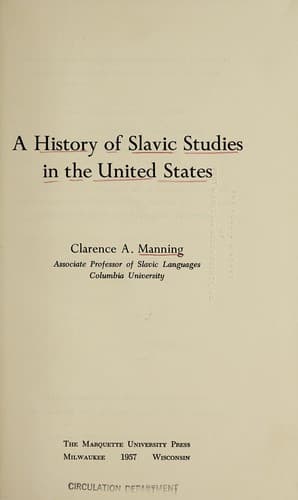
A history of Slavic studies in the United StatesManning, Clarence Augustus
History
A history of Slavic studies in the United States
Manning, Clarence Augustus
Slavic philology -- Study and teaching; Slavs -- History -- Study and teaching
The years of the depression, in many ways, produced another period of
marking time in Slavic studies. For the most part efforts of the Slavic
groups to introduce their languages into the American educational system
were retarded, while available finances were restricted to relief
purposes. In other cases, as among the Czechs, the hardships were
complicated by the death of such leaders as Reverend Vincent Pisek and
Professor Michael Pupin who had been active in stimulating cooperation
between the immigrant communities and the American educational system.
Their deaths at a critical period disrupted much of the work. Further,
the 1931 failure of the Bank of Europe Trust company in New York under
conditions which almost completely reimbursed the depositors,
nonetheless lessened the effectiveness of Thomas Capek, a leader in the
work. Similar disasters in other Slavic groups had similar nation-wide
effects and except for an effort to interest the Czech population in the
Chicago area to establish courses at the University of Illinois, the
period was destitute of that type of energetic development which, on the
eve of the depression, promised to bear such rich fruits.
In a lighter vein came the establishment of courses in Russian under the
NRA. It had been hoped by some that it might be possible to give relief
to at least some of the unemployed Russians by the establishment of free
courses in the language. The attempt was almost completely a failure.
The students lacked any serious desire to learn the language and the
instructors were no more anxious to teach it. One very well educated
Russian actually prepared a set of charts on Russian grammar which
purported to show that there were no exceptions to any syntactical rule
in Russian and he blandly presented to his class word forms that he knew
never existed even in the speech of the most illiterate. When he was
reprimanded, he calmly told the NRA supervisors that he knew that none
of his students intended to learn Russian, he wanted his money, and so
there was no reason to worry about what, or how he taught.
In 1934, a new development emerged which was to prove exceedingly
fruitful in later years. Largely under the influence of Professors Cross
and Patrick, a small sum of money was secured to establish an intensive
summer course in Russian for about 20 students. The course was held at
Harvard University the first year and was directly under the control of
Professor Patrick who had come from the University of California to
conduct it with the aid of some assistants. The experiment was
successful. In 1935, joint sessions were held at Columbia University and
were to a certain degree independent of the regular summer school
courses. Professor Patrick was assisted by Mrs. Mogilat of Columbia and
Dr. Jack A. Posin of the University of California. After 1935, the
course was held at the University of California, largely because of the
increasing illness of Professor Patrick.
Public-domain text, read in full here on John Shaqi.
Reviews
Reviews
No reviews yet
Be the first to share your thoughts on this work.
Join the Discussion
Join the discussion
Sign in to leave a comment or review.
Sign InorCreate an account