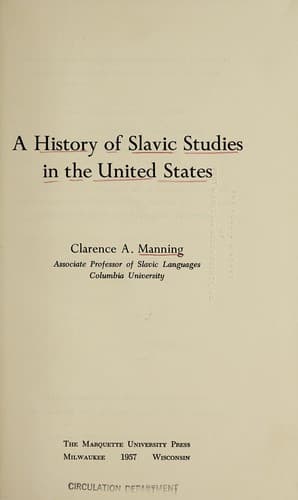
A history of Slavic studies in the United StatesManning, Clarence Augustus
History
A history of Slavic studies in the United States
Manning, Clarence Augustus
Slavic philology -- Study and teaching; Slavs -- History -- Study and teaching
In 1939, Cornell University invited Dr. Jack Posin to teach Russian and
in 1941 named Ernest J. Simmons Assistant Professor of English and
Russian. In 1942 Simmons was named chairman of a newly established
department of Russian, and, in 1945, was promoted to a full
professorship. Dr. Posin, meanwhile had transferred to the University of
Iowa, in 1942, as Assistant Professor of Russian.
At Syracuse University, Professor Albert Menut of the Department of
Romance Languages, a student of Russian, was able to develop courses in
Russian and to inaugurate a Russian program.
The extent of Slavic development during this period is revealed in a
survey conducted by Professor Arthur P. Coleman in 1945, which showed
eighty-one institutions offering courses in Russian and eleven in
Polish. At the same time, there were 147 schools and colleges offering
courses in Slavic history and culture. The increased interest in history
seems all to the good, but it can be noted that well over fifty
institutions offering work on Russian and Slavic subjects lacked
collateral courses in the languages. This, however, was a far smaller
proportion than existed in 1914. Furthermore, it was not a peculiarity
of the United States, for as late as 1924 in Germany there were
professors of East European history who looked askance at students
wasting their time on linguistic studies, for they preferred to have
them work from translations.
To secure a staff for the American expansion, particularly in Russian,
offered many difficulties. There had been almost no immigration of
Russians for many years and the bulk of the possible instructors were
persons who had come to the United States shortly after World War I.
These were the only ones with any special training, for during the
period between the wars, few young Russians from educated families had
seriously considered doing advanced work in Russian, even though there
were many with knowledge of the educational system. An outstanding
exception was Oleg Maslenikov who, at this time, joined the staff of the
University of California.
The chief emphasis, in this period of expansion, was on a speaking
knowledge of the language. Wherever it was possible, instruction was
begun under the supervision of some member of the faculty with a
knowledge of Russian, while much of the actual work was done by native
assistants. This combination, originally applied to Russian by Professor
Patrick, became the general rule and was successful where it was
intelligently used.
Public-domain text, read in full here on John Shaqi.
Reviews
Reviews
No reviews yet
Be the first to share your thoughts on this work.
Elsewhere in the archive
Join the Discussion
Join the discussion
Sign in to leave a comment or review.
Sign InorCreate an account