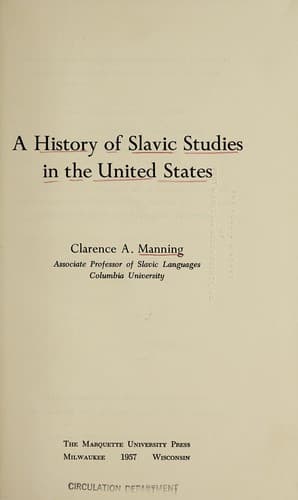
A history of Slavic studies in the United StatesManning, Clarence Augustus
History
A history of Slavic studies in the United States
Manning, Clarence Augustus
Slavic philology -- Study and teaching; Slavs -- History -- Study and teaching
The Poles were more fortunate, for during the crucial weeks of the
destruction of Poland, many of their leading scholars had been able to
escape north into Lithuania or south into Romania, from which countries
they made their way to the west. When they arrived in the United States,
the Polish organizations, working with the Polish Legation in
Washington, found funds to allow them to continue their scientific work.
To furnish a center for them and keep them from being lost in American
life, an American branch of the Polish Academy of Arts and Sciences in
Krakow was formed under the distinguished historian, Professor Oskar
Halecki. This was later reorganized as the Polish Institute of Arts and
Sciences in the United States. During the war years, it received
sufficient funds to publish a quarterly journal, the _Bulletin of the
Polish Institute of Arts and Sciences in America_, and to issue several
scholarly works on Polish subjects. Still later, when the Germans pushed
westward, other Polish scholars, such as Professor Waclaw Lednicki and
Professor Manfred Kridl, succeeded in reaching the United States. Most
of these men have since found places in the American scientific world.
Few distinguished Russian scholars arrived at this time and there was
only one Ukrainian, Professor Nicholas Chubaty, who almost by accident,
arrived in the United States for a meeting of _Pax Romana_, an
international organization for social action under the auspices of the
Catholic Church, and remained here after the outbreak of hostilities.
The Southern Slavs and Bulgarians fared even less well.
War produced, at first, relatively little effect upon Slavic studies as
a whole or Russian in particular. It was not until 1940 that there came
any appreciable increase in the number of students. Yet the general
reaction of the public differed from that of 1914. Despite the growth of
anti-Nazi and even anti-German feeling, there was no attempt to exclude
German from the curricula of any important institution. There was no
decline of students, but rather an increase. The same was true of
Russian, and long before 1941, the governing bodies of institutions
without Slavic departments began to think of introducing them. We can
only mention certain instances of this development.[38]
Professor Alfred Senn, a Swiss philologist from the University of
Kaunas, who held several positions in other institutions, became
Professor of German Philology at the University of Pennsylvania in 1938.
During World War II, he offered courses in Russian, and in 1948 became
Professor of Balto-Slavic Philology and head of the Department of
Balto-Slavic Studies. As such, he was able to group around him a number
of refugee scholars.
Public-domain text, read in full here on John Shaqi.
Reviews
Reviews
No reviews yet
Be the first to share your thoughts on this work.
Elsewhere in the archive
Join the Discussion
Join the discussion
Sign in to leave a comment or review.
Sign InorCreate an account