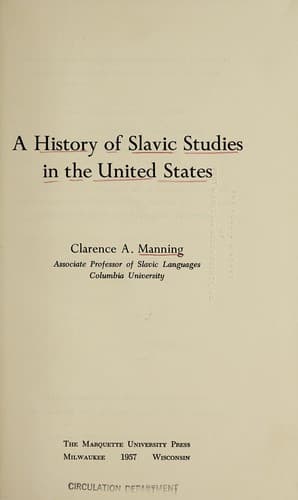
A history of Slavic studies in the United StatesManning, Clarence Augustus
History
A history of Slavic studies in the United States
Manning, Clarence Augustus
Slavic philology -- Study and teaching; Slavs -- History -- Study and teaching
There are, however, certain limitations which the student will
encounter, due largely at the present time to the rule in the free world
which prohibits a free exchange of students between countries. A student
desiring to work in English, French and German history can go freely to
the appropriate intellectual center to consult sources; a relatively
large number of students in these fields have studied at the
universities and archives of the country in which they were interested.
This was also true to a certain degree, between the wars, in the
so-called succession states when every year students went to the
universities of Poland, Czechoslovakia, Yugoslavia and Bulgaria, the
Baltic and Greece. Today this is impossible and the administration of
students’ programs must take this fact into account. The limitation
severely restricts research in certain slightly explored areas such as
the remains of Slavic literature from the Middle Ages, the unpublished
memoirs and manuscripts of many modern writers, and memorabilia from
many periods of historical and economic importance.
These limitations can be partly overcome by increased research in the
archives of many of the countries still free. There is doubtless much
material in the libraries of Western Europe, the Scandinavian countries,
Greece and Turkey which has never been adequately studied by a Slavic
expert.
Limitations exist to an even greater degree in archaeology and
ethnology, since research before World War I was still in its infancy
and subsequent discoveries have been filtered through the exigencies of
Russian Communist propaganda. This imposes upon the student the
necessity for a most thorough and careful analysis of all Soviet
references and newly published material, often edited to suit the policy
of the moment, for it often involves a direct contradiction to what the
Soviets declared to be true in the period between the two World Wars.
This is the situation not only in history, but also in the literature of
the past and present. The theses issued by the Communist Party for the
three hundredth anniversary of the Treaty of Pereyaslav (1654–1954),
after the death of Stalin and under the “new” Soviet policy, stand in
sharp contrast to the published statements of Soviet scholarship during
the 1920’s and 1930’s. Similarly, the rewriting of the biographies,
during the relatively unhampered conditions of the early 1920’s, of such
authors as Dostoyevsky, Shevchenko, Franko, Mickiewicz and many others,
makes it impossible to accept uncritically either the older Soviet
accounts or even much of the material published under the Tsarist
regime.
Public-domain text, read in full here on John Shaqi.
Reviews
Reviews
No reviews yet
Be the first to share your thoughts on this work.
Elsewhere in the archive
Join the Discussion
Join the discussion
Sign in to leave a comment or review.
Sign InorCreate an account