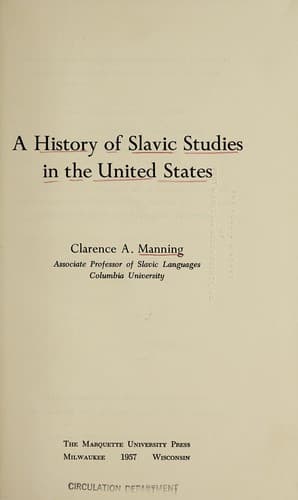
A history of Slavic studies in the United StatesManning, Clarence Augustus
History
A history of Slavic studies in the United States
Manning, Clarence Augustus
Slavic philology -- Study and teaching; Slavs -- History -- Study and teaching
From this point of view, area studies represent but a slight increase of
detailed knowledge over that which the average student acquires before
he begins specialization in any linguistic or historical field. This
knowledge must be supplemented by detailed studies in one of the
accepted fields of learning if the student is not to remain a talented
amateur.
But there is another aspect of area studies which has given them their
vogue at the present time. The global complexion of World War II brought
home to the American government, all far-sighted educators and even to
members of the general public, the tremendous ignorance which existed in
the United States concerning all parts of the world except some sections
of Western Europe. It was urgently necessary to prepare, in the minimum
time, relatively large numbers of individuals to serve throughout the
world. The involvement of the Soviet Union and the Nazi overrunning of
the states to its west further emphasized this need. Area studies were
the result.
These studies were definitely geared to educate men and women who could
be quickly called in case of need. That need still exists and
undoubtedly a large percentage of the students who enter such
concentrated programs hope to put their knowledge to practical use, for
the most part, outside the universities. There is still a great demand
for area courses and if ever the Iron Curtain were lifted and free
commercial relations reestablished, we would speedily find that even
with all these courses, the demand would outstrip the supply.
But, it seems likely that area studies will diminish in popularity if
Slavic and other East European studies find their rightful place in the
undergraduate curriculum and provide students with a real appreciation
of the significance and general culture of the area. If that were so,
they might continue with still greater detail, for an area study
including the entire Soviet Union and the satellites becomes almost a
contradiction in terms. It would be the same as if a student selected
North and South America for a single area study. It becomes very little
more than a brief survey of conditions in some particular field. This
danger has appeared already in places where area studies have been given
on the Slavic lands and have tended to become mere adjuncts of certain
phases of Russian and Communist politics and thought.
Public-domain text, read in full here on John Shaqi.
Reviews
Reviews
No reviews yet
Be the first to share your thoughts on this work.
Elsewhere in the archive
Join the Discussion
Join the discussion
Sign in to leave a comment or review.
Sign InorCreate an account