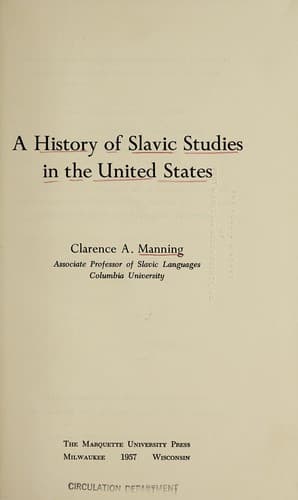
A history of Slavic studies in the United StatesManning, Clarence Augustus
History
A history of Slavic studies in the United States
Manning, Clarence Augustus
Slavic philology -- Study and teaching; Slavs -- History -- Study and teaching
In the same way, perhaps under the same roof, there could be a Slavic
museum not only for the major arts but also for articles of domestic
use. Early immigrants brought with them home-made utensils, weavings,
carpets, and dishes which now seem crude and are discarded. However,
their real value is suggested by the fact that the New York State
Historical Society has organized in Cooperstown an agricultural museum
to preserve similar articles made in the early United States. The
disappearance of the old way of life in Eastern Europe, evident even
before the Communist wave of devastation and the ravages of the War,
have given these articles, now in the United States a value far beyond
anything imagined a few years ago. Some organizations such as the Polish
Roman Catholic Union in Chicago, the Ukrainian Museums in Ontario,
California, Chicago and Cleveland, and other groups have made small
scale efforts to establish collections and libraries; some of them, such
as the Shevchenko Society library, the Ukrainian Academy of Sciences
library and the Hungarian Feleky library, have not yet found proper
housing. There are many other small and scattered museums and
collections. The development of a project on a continental scale would
at once reveal the similarities and dissimilarities existing among the
Slavic and East European peoples.
No single institution can possibly hope to achieve all this or to cover
adequately the subjects included in a careful survey and study of
Eastern Europe. Some new form of cooperation must be devised, if the
burden is not to become overwhelming and thus be neglected. It cuts
sharply in some respects across some of the American educational
traditions but the establishments of atomic laboratories sponsored by
several institutions, such as the Brookhaven laboratory, shows that
cooperation is possible.
These, then, are but a few possibilities for future expansion of Slavic
studies. The Slavic and East European studies in the United States are
still in their infancy and American scholars, whether of Slavic or
non-Slavic origin, have an enormous opportunity to push forward to solve
many of the problems which have, until now, isolated the peoples of
Eastern Europe and have barred them from playing their proper role in
world affairs.
Bibliography
Aldrich, Col. H. S. “Aims and Techniques in Language Teaching Today.”
(abstract) _AATSEEL Bulletin_, V (March, 1948), pp. 60–1.
Andrews, A. I. “University Courses Given in the United States of
America on Slavic and other Eastern European History, Languages and
Literature.” Reprinted from _Slavonic Review_, 1936.
“Area Study Programs—The Soviet Union and Eastern Europe,” edited by
Royden Dangerfield. Institute of Government and Public Affairs,
University of Illinois, 1955.
Bennett, W. C. “Area Studies in American Universities.” (_SSRC_),
Washington, 1951.
Public-domain text, read in full here on John Shaqi.
Reviews
Reviews
No reviews yet
Be the first to share your thoughts on this work.
Elsewhere in the archive
Join the Discussion
Join the discussion
Sign in to leave a comment or review.
Sign InorCreate an account