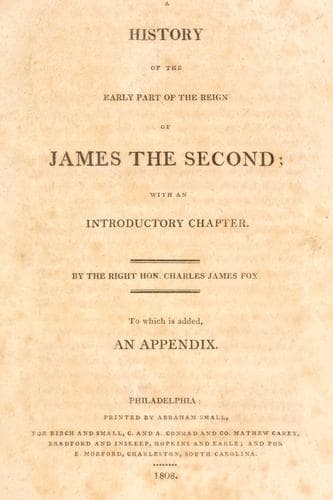
A History of the Early Part of the Reign of James the SecondFox, Charles James
History
A History of the Early Part of the Reign of James the Second
Fox, Charles James
Great Britain -- History -- James II, 1685-1688
of Presbyterians were still fresh in their memory. Not even the
persecution to which they had been in common, and almost indiscriminately
subjected, had reunited them. According to a most expressive phrase of
an eminent minister of their church, who sincerely lamented their
disunion, the furnace had not yet healed the rents and breaches among
them. Some doubted whether, short of establishing all the doctrines
preached by Cargill and Cameron, there was anything worth contending for;
while others, still further gone in enthusiasm, set no value upon
liberty, or even life itself, if they were to be preserved by the means
of a nobleman who had, as well by his serviced to Charles the Second as
by other instances, been guilty in the former parts of his conduct of
what they termed unlawful compliances.
Perplexed, no doubt, but not dismayed, by these difficulties, the earl
proceeded to Tarbet, which he had fixed as the place of rendezvous, and
there issued a second declaration (that which has been mentioned as
having been laid before the House of Commons), with as little effect as
the first. He was joined by Sir Duncan Campbell, who alone, of all his
kinsmen, seems to have afforded him any material assistance, and who
brought with him nearly a thousand men; but even with this important
reinforcement, his whole army does not appear to have exceeded two
thousand. It was here that he was over-ruled by a council of war, when
he proposed marching to Inverary; and after much debate, so far was he
from being so self-willed as he is represented, that he consented to go
over with his army to that part of Argyleshire called Cowal, and that Sir
John Cochrane should make an attempt upon the Lowlands; and he sent with
him Major Fullarton, one of the offices in whom he most trusted, and who
appears to have best deserved his confidence. This expedition could not
land in Ayrshire, where it had at first been intended, owing to the
appearance of two king's frigates, which had been sent into those seas;
and when it did land near Greenock, no other advantage was derived from
it than the procuring from the town a very small supply of provisions.
Public-domain text, read in full here on John Shaqi.
Reviews
Reviews
No reviews yet
Be the first to share your thoughts on this work.
Elsewhere in the archive
Join the Discussion
Join the discussion
Sign in to leave a comment or review.
Sign InorCreate an account