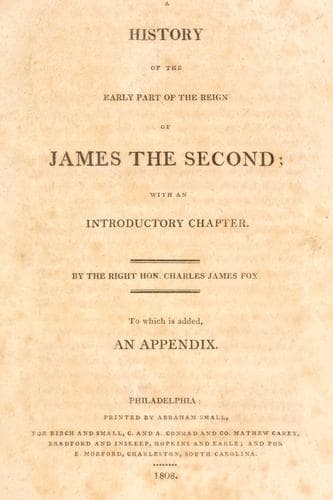
A History of the Early Part of the Reign of James the SecondFox, Charles James
History
A History of the Early Part of the Reign of James the Second
Fox, Charles James
Great Britain -- History -- James II, 1685-1688
On the 15th of June, his army being now increased to near three thousand
men, the duke marched from Lyme. He does not appear to have taken this
step with a view to any enterprise of importance, but rather to avoid the
danger which he apprehended from the motions of the Devonshire and
Somerset militias, whose object it seemed to be to shut him up in Lyme.
In his first day's march he had opportunities of engaging, or rather of
pursuing, each of those bodies, who severally retreated from his forces;
but conceiving it to be his business, as he said, not to fight, but to
march on, he went through Axminster, and encamped in a strong piece of
ground between that town and Chard in Somersetshire, to which place he
proceeded on the ensuing day. According to Wade's narrative, which
appears to afford by far the most authentic account of these
transactions, here it was that the first proposition was made for
proclaiming Monmouth king. Ferguson made the proposal, and was supported
by Lord Grey, but it was easily run down, as Wade expresses it, by those
who were against it, and whom, therefore, we must suppose to have formed
a very considerable majority of the persons deemed of sufficient
importance to be consulted on such an occasion. These circumstances are
material, because if that credit be given to them which they appear to
deserve, Ferguson's want of veracity becomes so notorious, that it is
hardly worth while to attend to any part of his narrative. Where it only
corroborates accounts given by others, it is of little use; and where it
differs from them, it deserves no credit. I have, therefore, wholly
disregarded it.
From Chard, Monmouth and his party proceeded to Taunton, a town where, as
well from the tenor of former occurrences as from the zeal and number of
the Protestant dissenters, who formed a great portion of its inhabitants,
he had every reason to expect the most favourable reception. His
expectations were not disappointed.
The inhabitants of the upper, as well as the lower classes, vied with
each other in testifying their affection for his person, and their zeal
for his cause. While the latter rent the air with applauses and
acclamations, the former opened their houses to him and to his followers,
and furnished his army with necessaries and supplies of every kind. His
way was strewed with flowers; the windows were thronged with spectators,
all anxious to participate in what the warm feelings of the moment made
them deem a triumph. Husbands pointed out to their wives, mothers to
their children, the brave and lovely hero who was destined to be the
deliverer of his country. The beautiful lines which Dryden makes
Achitophel, in his highest strain of flattery, apply to this unfortunate
nobleman, were in this instance literally verified:
"Thee, saviour, thee, the nation's vows confess,
And, never satisfied with seeing, bless.
Swift unbespoken pomps thy steps proclaim,
And stammering babes are taught to lisp thy name."
Public-domain text, read in full here on John Shaqi.
Reviews
Reviews
No reviews yet
Be the first to share your thoughts on this work.
Elsewhere in the archive
Join the Discussion
Join the discussion
Sign in to leave a comment or review.
Sign InorCreate an account