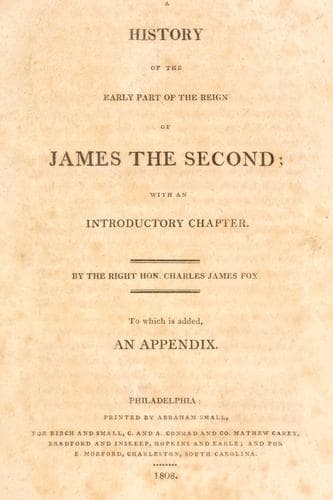
A History of the Early Part of the Reign of James the SecondFox, Charles James
History
A History of the Early Part of the Reign of James the Second
Fox, Charles James
Great Britain -- History -- James II, 1685-1688
The notion of improving his new levies by discipline seems to have taken
such possession of Monmouth's mind that he overlooked the probable, or
rather the certain, consequences of a delay, by which the enemy would be
enabled to bring into the field forces far better disciplined and
appointed than any which, even with the most strenuous and successful
exertions, he could hope to oppose to them. Upon this principle, and
especially as he had not yet fixed upon any definite object of
enterprise, he did not think a stay of a few days at Taunton would be
materially, if at all, prejudicial to his affairs; and it was not till
the 21st of June that he proceeded to Bridgewater, where he was received
in the most cordial manner. In his march, the following day, from that
town to Glastonbury, he was alarmed by a party of the Earl of Oxford's
horse; but all apprehensions of any material interruptions were removed
by an account of the militia having left Wells, and retreated to Bath and
Bristol. From Glastonbury he went to Shipton-Mallet, where the project
of an attack upon Bristol was communicated by the duke to his officers.
After some discussion, it was agreed that the attack should be made on
the Gloucestershire side of the city, and with that view to pass the Avon
at Keynsham Bridge, a few miles from Bath. In their march from Shipton-
Mallet, the troops were again harassed in their rear by a party of horse
and dragoons, but lodged quietly at night at a village called Pensford. A
detachment was sent early the next morning to possess itself of Keynsham,
and to repair the bridge, which might probably be broken down to prevent
a passage. Upon their approach, a troop of the Gloucestershire horse-
militia immediately abandoned the town in great precipitation, leaving
behind them two horses and one man. By break of day, the bridge, which
had not been much injured, was repaired, and before noon, Monmouth,
having passed it with his whole army, was in full march to Bristol, which
he determined to attack the ensuing night. But the weather proving rainy
and bad, it was deemed expedient to return to Keynsham, a measure from
which he expected to reap a double advantage; to procure dry and
commodious quarters for the soldiery, and to lull the enemy, by a
movement, which bore the semblance of a retreat, into a false and
delusive security. The event, however, did not answer his expectation,
for the troops had scarcely taken up their quarters, when they were
disturbed by two parties of horse, who entered the town at two several
places. An engagement ensued, in which Monmouth lost fourteen men, and a
captain of horse, though in the end the Royalists were obliged to retire,
leaving three prisoners. From these the duke had information that the
king's army was near at hand, and, as they said, about four thousand
strong.
Public-domain text, read in full here on John Shaqi.
Reviews
Reviews
No reviews yet
Be the first to share your thoughts on this work.
Elsewhere in the archive
Join the Discussion
Join the discussion
Sign in to leave a comment or review.
Sign InorCreate an account