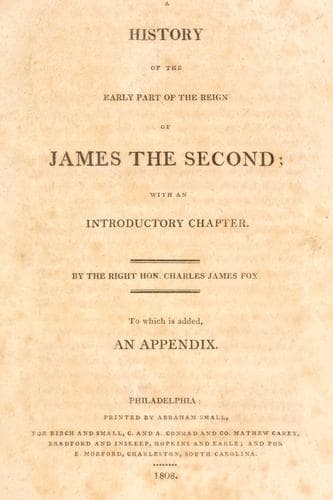
A History of the Early Part of the Reign of James the SecondFox, Charles James
History
A History of the Early Part of the Reign of James the Second
Fox, Charles James
Great Britain -- History -- James II, 1685-1688
This transaction took place the 25th, the day before Monmouth's arrival
at Philip's Norton, and may have, in a considerable degree, contributed
to the disappointment, of which we learn from Wade, that he at this time
began bitterly to complain. He was now upon the confines of Wiltshire,
and near enough for the bodies of horse, upon whose favourable intentions
so much reliance had been placed, to have effected a junction, if they
had been so disposed; but whether that Adlam's intelligence had been
originally bad, or that Pembroke's proceedings at Froome had intimidated
them, no symptom of such an intention could be discovered. A desertion
took place in his army, which the exaggerated accounts in the Gazette
made to amount to near two thousand men. These dispiriting
circumstances, added to the complete disappointment of the hopes
entertained from the assumption of the royal title, produced in him a
state of mind but little short of despondency. He complained that all
people had deserted him, and is said to have been so dejected, as hardly
to have the spirit requisite for giving the necessary orders.
From this state of torpor, however, he appears to have been effectually
roused by a brisk attack that was made upon him on the 27th, in the
morning, by the Royalists, under the command of his half-brother, the
Duke of Grafton. That spirited young nobleman (whose intrepid courage,
conspicuous upon every occasion, led him in this, and many other
instances, to risk a life, which he finally lost in a better cause),
heading an advanced detachment of Lord Feversham's army, who had marched
from Bath, with a view to fall on the enemy's rear, marched boldly up a
narrow lane leading to the town, and attacked a barricade, which Monmouth
had caused to be made across the way, at the entrance of the town.
Monmouth was no sooner apprised of this brisk attack, than he ordered a
party to go out of the town by a by-way, who coming on the rear of the
Grenadiers while others of his men were engaged with their front, had
nearly surrounded them, and taken their commander prisoner, but Grafton
forced his way through the enemy. An engagement ensued between the
insurgents and the remainder of Feversham's detachment, who had lined the
hedges which flanked them. The former were victorious, and after driving
the enemy from hedge to hedge, forced them at last into the open field,
where they joined the rest of the king's forces, newly come up. The
killed and wounded in these encounters amounted to about forty on
Feversham's side, twenty on Monmouth's; but among the latter there were
several officers, and some of note, while the loss of the former, with
the exception of two volunteers, Seymour and May, consisted entirely of
common soldiers.
Public-domain text, read in full here on John Shaqi.
Reviews
Reviews
No reviews yet
Be the first to share your thoughts on this work.
Elsewhere in the archive
Join the Discussion
Join the discussion
Sign in to leave a comment or review.
Sign InorCreate an account