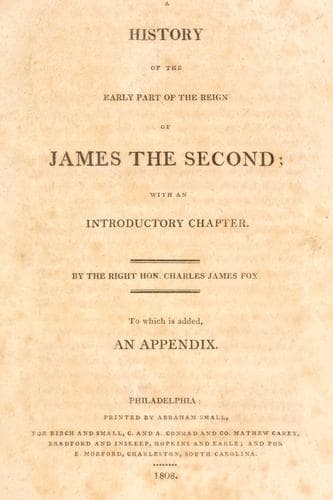
A History of the Early Part of the Reign of James the SecondFox, Charles James
History
A History of the Early Part of the Reign of James the Second
Fox, Charles James
Great Britain -- History -- James II, 1685-1688
His preparations for this march were all made, when, on the afternoon of
the 5th, he learnt, more accurately than he had before done, the true
situation of the royal army, and from the information now received, he
thought it expedient to consult his principal officers, whether it might
not be advisable to attempt to surprise the enemy by a night attack upon
their quarters. The prevailing opinion was, that if the infantry were
not entrenched the plan was worth the trial; otherwise not. Scouts were
despatched to ascertain this point, and their report being that there was
no entrenchment, an attack was resolved on. In pursuance of this
resolution, at about eleven at night, the whole army was in march, Lord
Grey commanding the horse, and Colonel Wade the vanguard of the foot. The
duke's orders were, that the horse should first advance, and pushing into
the enemy's camp, endeavour to prevent their infantry from coming
together; that the cannon should follow the horse, and the foot the
cannon, and draw all up in one line, and so finish what the cavalry
should have begun, before the king's horse and artillery could be got in
order. But it was now discovered that though there were no
entrenchments, there was a ditch which served as a drain to the great
moor adjacent, of which no mention had been made by the scouts. To this
ditch the horse under Lord Grey advanced, and no farther; and whether
immediately, as according to some accounts, or after having been
considerably harassed by the enemy in their attempts to find a place to
pass, according to others, quitted the field. The cavalry being gone,
and the principle upon which the attack had been undertaken being that of
a surprise, the duke judged it necessary that the infantry should advance
as speedily as possible. Wade, therefore, when he came within forty
paces of the ditch, was obliged to halt to put his battalion into that
order, which the extreme rapidity of the march had for the time
disconcerted. His plan was to pass the ditch, reserving his fire; but
while he was arranging his men for that purpose, another battalion, newly
come up, began to fire, though at a considerable distance; a bad example,
which it was impossible to prevent the vanguard from following, and it
was now no longer in the power of their commander to persuade them to
advance. The king's forces, as well horse and artillery as foot, had now
full time to assemble. The duke had no longer cavalry in the field, and
though his artillery, which consisted only of three or four iron guns,
was well served under the directions of a Dutch gunner, it was by no
means equal to that of the royal army, which, as soon as it was light,
began to do great execution. In these circumstances the unfortunate
Monmouth, fearful of being encompassed and made prisoner by the king's
cavalry, who were approaching upon his flank, and urged, as it is
reported, to flight by the same person who had stimulated him to his
Public-domain text, read in full here on John Shaqi.
Reviews
Reviews
No reviews yet
Be the first to share your thoughts on this work.
Elsewhere in the archive
Join the Discussion
Join the discussion
Sign in to leave a comment or review.
Sign InorCreate an account