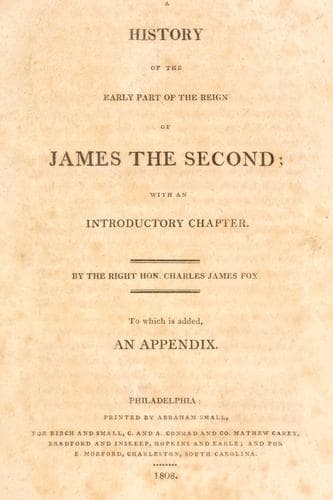
A History of the Early Part of the Reign of James the SecondFox, Charles James
History
A History of the Early Part of the Reign of James the Second
Fox, Charles James
Great Britain -- History -- James II, 1685-1688
The intriguing character of the Secretary of State, the Earl of
Sunderland, whose duplicity in many instances cannot be doubted, and the
mystery in which almost everything relating to him is involved, might
lead us to suspect that the expressions point at some discovery in which
that nobleman was concerned, and that Monmouth had it in his power to be
of important service to James, by revealing to him the treachery of his
minister. Such a conjecture might be strengthened by an anecdote that
has had some currency, and to the truth of which, in part, King James's
"Memoirs," if the extracts from them can be relied on, bear testimony. It
is said that the Duke of Monmouth told Mr. Ralph Sheldon, one of the
king's chamber, who came to meet him on his way to London, that he had
had reason to expect Sunderland's co-operation, and authorised Sheldon to
mention this to the king: that while Sheldon was relating this to his
majesty, Sunderland entered; Sheldon hesitated, but was ordered to go on.
"Sunderland seemed, at first, struck" (as well he might, whether innocent
or guilty), "but after a short time said, with a laugh, 'If that be all
he (Monmouth) can discover to save his life, it will do him little
good.'" It is to be remarked, that in Sheldon's conversation, as alluded
to by King James, the Prince of Orange's name is not even mentioned,
either as connected with Monmouth or with Sunderland. But, on the other
hand, the difficulties that stand in the way of our interpreting
Monmouth's letter as alluding to Sunderland, or of supposing that the
writer of it had any well-founded accusation against that minister, are
insurmountable. If he had such an accusation to make, why did he not
make it? The king says expressly, both in a letter to the Prince of
Orange, and in the extract, from his "Memoirs," above cited, that
Monmouth made no discovery of consequence, and the explanation suggested,
that his silence was owing to Sunderland the secretary's having assured
him of his pardon, seems wholly inadmissible. Such assurances could have
their influence no longer than while the hope of pardon remained. Why,
then, did he continue silent, when he found James inexorable? If he was
willing to accuse the earl before he had received these assurances, it is
inconceivable that he should have any scruple about doing it when they
turned out to have been delusive, and when his mind must have been
exasperated by the reflection that Sunderland's perfidious promises and
self-interested suggestions had deterred him from the only probable means
of saving his life.
Public-domain text, read in full here on John Shaqi.
Reviews
Reviews
No reviews yet
Be the first to share your thoughts on this work.
Elsewhere in the archive
Join the Discussion
Join the discussion
Sign in to leave a comment or review.
Sign InorCreate an account