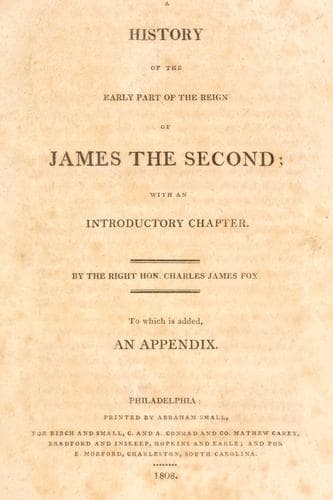
A History of the Early Part of the Reign of James the SecondFox, Charles James
History
A History of the Early Part of the Reign of James the Second
Fox, Charles James
Great Britain -- History -- James II, 1685-1688
Robert Spencer, Earl of Sunderland, who was continued as secretary of
state, had been at one period a supporter of the exclusion bill, and had
been suspected of having offered the Duchess of Portsmouth to obtain the
succession to the crown for her son, the Duke of Richmond. Nay more,
King James, in his "Memoirs," charges him with having intended, just at
the time of Charles's death, to send him into a second banishment; but
with regard to this last point, it appears evident to me, that many
things in those "Memoirs," relative to this earl, were written after
James's abdication, and in the greatest bitterness of spirit, when he was
probably in a frame of mind to believe anything against a person by whom
he conceived himself to have been basely deserted. The reappointment,
therefore, of this nobleman to so important an office, is to be accounted
for partly upon the general principle above-mentioned, of making the new
reign a mere continuation of the former, and partly upon Sunderland's
extraordinary talents for ingratiating himself with persons in power, and
persuading them that he was the fittest instrument for their purposes; a
talent in which he seems to have surpassed all the intriguing statesmen
of his time, or perhaps of any other.
An intimate connection with the court of Versailles being the principal
engine by which the favourite project of absolute monarchy was to be
effected, James, for the purpose of fixing and cementing that connection,
sent for M. de Barillon, the French ambassador, the very day after his
accession, and entered into the most confidential discourse with him. He
explained to him his motives for intending to call a parliament, as well
as his resolution to levy by authority the revenue which his predecessor
had enjoyed in virtue of a grant of parliament which determined with his
life. He made general professions of attachment to Louis, declared that
in all affairs of importance it was his intention to consult that
monarch, and apologised, upon the ground of the urgency of the case, for
acting in the instance mentioned without his advice. Money was not
directly mentioned, owing, perhaps, to some sense of shame upon that
subject, which his brother had never experienced; but lest there should
be a doubt whether that object were implied in the desire of support and
protection, Rochester was directed to explain the matter more fully, and
to give a more distinct interpretation of these general terms.
Accordingly, that minister waited the next morning upon Barillon, and
after having repeated and enlarged upon the reasons for calling a
parliament, stated, as an additional argument in defence of the measure,
that without it his master would become too chargeable to the French
king; adding, however, that the assistance which might be expected from a
parliament, did not exempt him altogether from the necessity of resorting
to that prince for pecuniary aids; for that without such, he would be at
Public-domain text, read in full here on John Shaqi.
Reviews
Reviews
No reviews yet
Be the first to share your thoughts on this work.
Join the Discussion
Join the discussion
Sign in to leave a comment or review.
Sign InorCreate an account