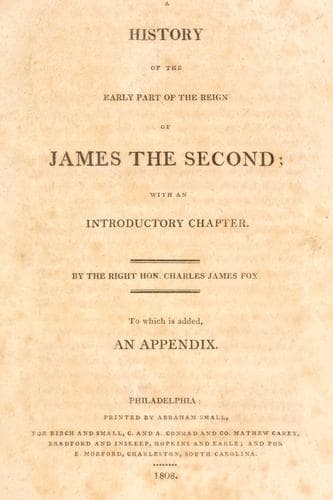
A History of the Early Part of the Reign of James the SecondFox, Charles James
History
A History of the Early Part of the Reign of James the Second
Fox, Charles James
Great Britain -- History -- James II, 1685-1688
the mercy of his subjects, and that upon this beginning would depend the
whole fortune of the reign. If Rochester actually expressed himself as
Barillon relates, the use intended to be made of parliament cannot but
cause the most lively indignation, while it furnishes a complete answer
to the historians who accuse the parliaments of those days of
unseasonable parsimony in their grants to the Stuart kings; for the
grants of the people of England were not destined, it seems, to enable
their kings to oppose the power of France, or even to be independent of
her, but to render the influence which Louis was resolved to preserve in
this country less chargeable to him, by furnishing their quota to the
support of his royal dependant.
The French ambassador sent immediately a detailed account of these
conversations to his court, where, probably, they were not received with
the less satisfaction on account of the request contained in them having
been anticipated. Within a very few days from that in which the latter
of them had passed, he was empowered to accompany the delivery of a
letter from his master, with the agreeable news of having received from
him bills of exchange to the amount of five hundred thousand livres, to
be used in whatever manner might be convenient to the king of England's
service. The account which Barillon gives, of the manner in which this
sum was received, is altogether ridiculous: the king's eyes were full of
tears, and three of his ministers, Rochester, Sunderland, and Godolphin,
came severally to the French ambassador, to express the sense their
master had of the obligation, in terms the most lavish. Indeed,
demonstrations of gratitude from the king directly, as well as through
his ministers, for this supply were such, as if they had been used by
some unfortunate individual, who, with his whole family, had been saved,
by the timely succour of some kind and powerful protector, from a gaol
and all its horrors, would be deemed rather too strong than too weak.
Barillon himself seems surprised when he relates them; but imputes them
to what was probably their real cause, to the apprehensions that had been
entertained (very unreasonable ones!) that the king of France might no
longer choose to interfere in the affairs of England, and consequently
that his support could not be relied on for the grand object of
assimilating this government to his own.
Public-domain text, read in full here on John Shaqi.
Reviews
Reviews
No reviews yet
Be the first to share your thoughts on this work.
Join the Discussion
Join the discussion
Sign in to leave a comment or review.
Sign InorCreate an account