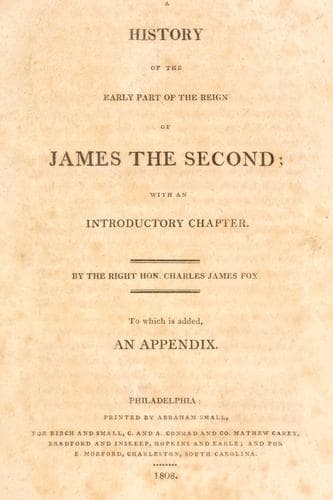
A History of the Early Part of the Reign of James the SecondFox, Charles James
History
A History of the Early Part of the Reign of James the Second
Fox, Charles James
Great Britain -- History -- James II, 1685-1688
The principal parties in the business, besides the king himself, to whose
capacity, at least, if not to his situation it was more suitable, and
Lord Churchill, who acted as an inferior agent, were Sunderland,
Rochester, and Godolphin, all men of high rank and considerable
abilities, but whose understandings, as well as their principles, seem to
have been corrupted by the pernicious schemes in which they were engaged.
With respect to the last-mentioned nobleman in particular, it is
impossible, without pain, to see him engaged in such transactions. With
what self-humiliation must he not have reflected upon them in subsequent
periods of his life! How little could Barillon guess that he was
negotiating with one who was destined to be at the head of an
administration which, in a few years, would send the same Lord Churchill
not to Paris, to implore Louis for succours towards enslaving England, or
to thank him for pensions to her monarch, but to combine all Europe
against him in the cause of liberty, to rout his armies, to take his
towns, to humble his pride, and to shake to the foundation that fabric of
power which it had been the business of a long life to raise, at the
expense of every sentiment of tenderness to his subjects, and of justice
and good faith to foreign nations. It is with difficulty the reader can
persuade himself that the Godolphin and Churchill here mentioned are the
same persons who were afterwards one in the cabinet, one in the field,
the great conductors of the war of the succession. How little do they
appear in one instance! how great in the other! And the investigation of
the cause to which this excessive difference is principally owing, will
produce a most useful lesson. Is the difference to be attributed to any
superiority of genius in the prince whom they served in the latter period
of their lives? Queen Anne's capacity appears to have been inferior even
to her father's. Did they enjoy in a greater degree her favour and
confidence? The very reverse is the fact. But in one case they were the
tools of a king plotting against his people; in the other, the ministers
of a free government acting upon enlarged principles, and with energies
which no state that is not in some degree republican can supply. How
forcibly must the contemplation of these men, in such opposite
situations, teach persons engaged in political life that a free and
popular government is desirable, not only for the public good, but for
their own greatness and consideration, for every object of generous
ambition!
Public-domain text, read in full here on John Shaqi.
Reviews
Reviews
No reviews yet
Be the first to share your thoughts on this work.
Elsewhere in the archive
Join the Discussion
Join the discussion
Sign in to leave a comment or review.
Sign InorCreate an account