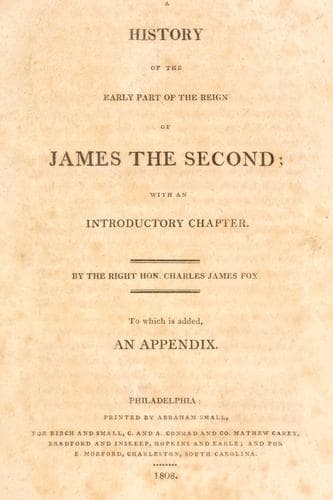
A History of the Early Part of the Reign of James the SecondFox, Charles James
History
A History of the Early Part of the Reign of James the Second
Fox, Charles James
Great Britain -- History -- James II, 1685-1688
The king having, as has been related, first privately communicated his
intentions to the French ambassador, issued proclamations for the meeting
of parliament, and for levying, upon his sole authority, the customs and
other duties which had constituted part of the late king's revenue, but
to which, the acts granting them having expired with the prince, James
was not legally entitled. He was advised by Lord Guildford, whom he had
continued in the office of keeper of the great seal, and who upon such a
subject, therefore, was a person likely to have the greatest weight, to
satisfy himself with directing the money to be kept in the exchequer for
the disposal of parliament, which was shortly to meet; and by others, to
take bonds from the merchants for the duties, to be paid when parliament
should legalise them. But these expedients were not suited to the king's
views, who, as well on account of his engagement with France, as from his
own disposition, was determined to take no step that might indicate an
intention of governing by parliaments, or a consciousness of his being
dependent upon them for his revenue, he adopted, therefore, the advice of
Jeffreys, advice not resulting so much, probably, either from ignorance
or violence of disposition, as from his knowledge that it would be most
agreeable to his master, and directed the duties to be paid as in the
former reign. It was pretended, that an interruption in levying some of
the duties might be hurtful to trade; but as every difficulty of that
kind was obviated by the expedients proposed, this arbitrary and violent
measure can with no colour be ascribed to a regard to public convenience,
nor to any other motive than to a desire of reviving Charles I.'s claims
to the power of taxation, and of furnishing a most intelligible comment
upon his speech to the council on the day of his accession. It became
evident what the king's notions were, with respect to that regal
prerogative from which he professed himself determined never to depart,
and to that property which he would never invade. What were the
remaining rights and liberties of the nation, which he was to preserve,
might be more difficult to discover; but that the laws of England, in the
royal interpretation of them, were sufficient to make the king as great a
monarch as he, or, indeed, any prince could desire, was a point that
could not be disputed. This violation of law was in itself most
flagrant; it was applied to a point well understood, and thought to have
been so completely settled by repeated and most explicit declarations of
the legislature, that it must have been doubtful whether even the most
corrupt judges, if the question had been tried, would have had the
audacity to decide it against the subject. But no resistance was made;
nor did the example of Hampden, which a half century before had been so
successful, and rendered that patriot's name so illustrious, tempt any
Public-domain text, read in full here on John Shaqi.
Reviews
Reviews
No reviews yet
Be the first to share your thoughts on this work.
Elsewhere in the archive
Join the Discussion
Join the discussion
Sign in to leave a comment or review.
Sign InorCreate an account