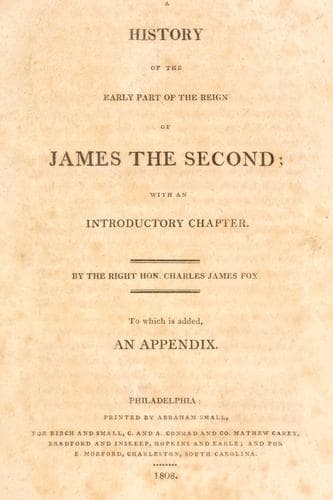
A History of the Early Part of the Reign of James the SecondFox, Charles James
History
A History of the Early Part of the Reign of James the Second
Fox, Charles James
Great Britain -- History -- James II, 1685-1688
one to emulate his fame, so completely had the crafty and sanguinary
measures of the late reign attained the object to which they were
directed, and rendered all men either afraid or unwilling to exert
themselves in the cause of liberty.
On the other hand, addresses the most servile were daily sent to the
throne. That of the University of Oxford stated that the religion which
they professed bound them to unconditional obedience to their sovereign
without restrictions or limitations; and the Society of Barristers and
Students of the Middle Temple thanked his majesty for the attention he
had shown to the trade of the kingdom, concerning which, and its balance
(and upon this last article they laid particular stress), they seemed to
think themselves peculiarly called upon to deliver their opinion. But
whatever might be their knowledge in matters of trade, it was at least
equal to that which these addressers showed in the laws and constitution
of their country, since they boldly affirmed the king's right to levy the
duties, and declared that it had never been disputed but by persons
engaged, in what they were pleased to call rebellion against his royal
father. The address concluded with a sort of prayer that all his
majesty's subjects might be as good lawyers as themselves, and disposed
to acknowledge the royal prerogative in all its extent.
If these addresses are remarkable for their servility, that of the
gentlemen and freeholders of the county of Suffolk was no less so for the
spirit of party violence that was displayed in it. They would take care,
they said, to choose representatives who should no more endure those who
had been for the Exclusion Bill, than the last parliament had the
abhorrers of the association; and thus not only endeavoured to keep up
his majesty's resentment against a part of their fellow-subjects, but
engaged themselves to imitate, for the purpose of retaliation, that part
of the conduct of their adversaries which they considered as most illegal
and oppressive.
Public-domain text, read in full here on John Shaqi.
Reviews
Reviews
No reviews yet
Be the first to share your thoughts on this work.
Elsewhere in the archive
Join the Discussion
Join the discussion
Sign in to leave a comment or review.
Sign InorCreate an account