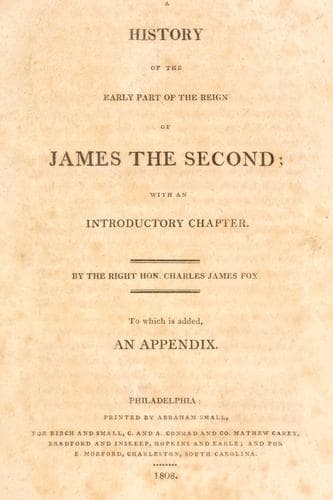
A History of the Early Part of the Reign of James the SecondFox, Charles James
History
A History of the Early Part of the Reign of James the Second
Fox, Charles James
Great Britain -- History -- James II, 1685-1688
if we consider it, which history well warrants us to do, as a part of
that system which had been pursued by all the Stuart kings, as well prior
as subsequent to the restoration, the lesson which it affords is very
different, as well as far more instructive. We are taught, generally,
the dangers Englishmen will always be liable to, if, from favour to a
prince upon the throne, or from a confidence, however grounded, that his
views are agreeable to our own notions of the constitution, we in any
considerable degree abate of that vigilant and unremitting jealousy of
the power of the crown, which can alone secure to us the effect of those
wise laws that have been provided for the benefit of the subject: and
still more particularly, that it is in vain to think of making a
compromise with power, and by yielding to it in other points, preserving
some favourite object, such, for instance, as the Church in James's case,
from its grasp.
Previous to meeting his English parliament, James directed a parliament
which had been summoned in the preceding reign, to assemble at Edinburgh,
and appointed the Duke of Queensbury his commissioner. This appointment
is, in itself, a strong indication that the king's views, with regard to
Scotland at least, were similar to those which I have ascribed to him in
England; and that they did not at that time extend to the introduction of
popery, but were altogether directed to the establishment of absolute
power as the _end_, and to the support of an episcopal church, upon the
model of the Church of England, as the _means_. For Queensbury had
explained himself to his majesty in the fullest manner upon the subject
of religion; and while he professed himself to be ready (as, indeed, his
conduct in the late reign had sufficiently proved) to go any length in
supporting royal power and in persecuting the Presbyterians, had made it
a condition of his services, that he might understand from his majesty
that there was no intention of changing the established religion; for if
such was the object, he could not make any one step with him in that
matter. James received this declaration most kindly, assured him he had
no such intention, and that he would have a parliament, to which he,
Queensbury, should go as commissioner, and giving all possible assurances
in the matter of religion, get the revenue to be settled, and such other
laws to be passed as might be necessary for the public safety. With
these promises the duke was not only satisfied at the time, but declared,
at a subsequent period, that they had been made in so frank and hearty a
manner, as made him conclude that it was impossible the king should be
acting a part. And this nobleman was considered, and is handed down to
us by contemporary writers, as a man of a penetrating genius, nor has it
ever been the national character of the country to which he belonged to
be more liable to be imposed upon than the rest of mankind.
Public-domain text, read in full here on John Shaqi.
Reviews
Reviews
No reviews yet
Be the first to share your thoughts on this work.
Elsewhere in the archive
Join the Discussion
Join the discussion
Sign in to leave a comment or review.
Sign InorCreate an account